How to Start a Blog and Make Money in 2026: Complete Beginner's Guide

Learn how to start a blog and make money in 2025. This complete guide for US beginners covers setup, SEO, affiliate marketing, and realistic income timelines.
Introduction: Can You Really Make Money Blogging in 2026?
If you've ever searched 'how to make money blogging,' you've probably landed on articles promising $10,000 in your first month. Let's be honest: that's not realistic for most people especially not in the USA where competition is real, but opportunity is even bigger.
The truth? Blogging is one of the most reliable ways to build passive income in the United States. Thousands of American bloggers earn anywhere from a few hundred dollars a month to six figures annually. But it takes strategy, patience, and the right roadmap.
This guide gives you everything you need: how to set up your blog the right way, choose a profitable niche, write content that ranks on Google, and monetize it with affiliate marketing and more all built for a US audience.
✅ What You'll Learn in This Guide
• How long it realistically takes to earn money blogging (US timeline)
• The best blogging platforms for beginners in 2026
• How to pick a profitable niche with real US demand
• SEO fundamentals that get your blog ranked on Google
• How to earn money through affiliate marketing and other US-based programs
• Realistic income milestones: $0 → $500 → $5,000/month
Section 1: How Long Does It Take to Make Money Blogging?
This is the most important question to answer before you write a single word. Setting realistic expectations is what separates bloggers who succeed from the 95% who quit within 6 months.
Realistic Income Timeline for US Bloggers
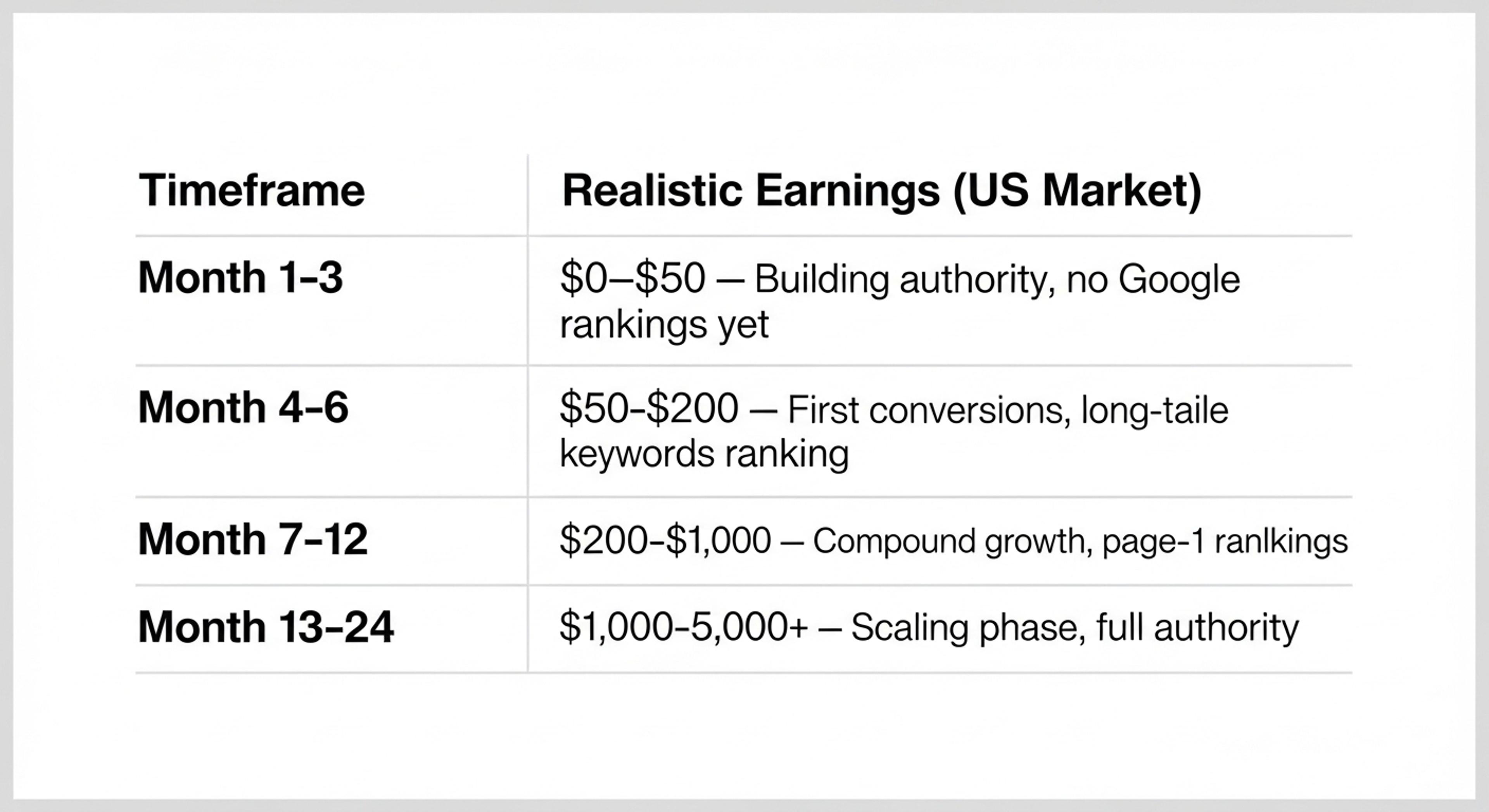
Bottom line: Expect 3–6 months before your first dollar, and 12–24 months before meaningful income ($500+/month). This is normal — don't quit early.
💡 Why the US Market Is Different
• US-based affiliate programs (Amazon Associates US, Bluehost, ConvertKit) pay significantly higher commissions than most other markets.
• US audiences spend more per capita on digital products and services.
• FTC disclosure requirements apply to all US bloggers — include a disclosure on every page with affiliate links.
• Tax note: Blogging income in the USA is typically reported as self-employment income (1099). Keep records from day one.
Section 2: Choose Your Blogging Platform (Best Options for 2026)
The platform you choose determines your long-term earning potential. Here's a no-nonsense breakdown for US beginners:
WordPress.org (Self-Hosted) — Best for Monetization
Why it wins: Full control, unlimited affiliate link placement, SEO-friendly, access to plugins like Rank Math and Yoast. This is what serious US bloggers use.
Cost: $3–$10/month hosting (Bluehost, SiteGround, or Cloudways) + ~$15/year for a domain via Namecheap or Google Domains.
Who it's for: Anyone serious about earning money. Slight learning curve, but manageable within a weekend.
Medium — Best for Beginners Who Want to Write First
Why consider it: Zero setup, built-in audience, free. The Medium Partner Program pays based on reading time.
Limitation: You don't own your content or audience. Difficult to run affiliate links. Not recommended if income is your primary goal.
Substack — Best for Newsletter-First Blogging
Why consider it: Great for building a paid newsletter audience. Free to start; Substack takes 10% of paid subscriptions.
Limitation: Limited SEO potential. Best as a supplement to a WordPress blog, not a replacement.
📌 Our Recommendation for US Bloggers
Start with WordPress.org + Bluehost hosting. It's the most beginner-friendly path to real monetization.
Cost: ~$3.95/month for hosting + $15/year domain = under $65/year to start.
→ See our full guide: "Best Blogging Platforms for Beginners in 2026"
Section 3: Choose a Profitable Blog Niche
Your niche is the topic your blog focuses on. The biggest mistake new bloggers make? Picking something they love but nobody searches for — or picking something so generic it's impossible to rank for.
The 3-Part Niche Test
- Is there US search demand? (Use Google's free Keyword Planner or Ubersuggest to check)
- Are there affiliate programs in this niche? (Can you earn commissions on products people buy?)
- Can you write 20+ articles on this topic? (Enough to build a content cluster)
Pro tip: Don't pick the niche, pick the angle. Instead of "health," choose "gut health for busy American moms over 40." Micro-niches have less competition and more loyal readers.
📌 Related Guide
Section 4: Set Up Your Blog (Technical Setup Checklist)
Once you've chosen a niche and platform, setting up your blog takes less than a day. Here's the order of operations:
- Buy a domain name — Use Namecheap or Google Domains (~$15/year). Choose a .com, keep it short and niche-relevant.
- Choose US-based hosting — Bluehost starts at $2.95/month. SiteGround offers better speed for ~$4.99/month. Both have one-click WordPress installation.
- Install WordPress — Available in your hosting dashboard. Takes 5 minutes.
- Install a lightweight theme — GeneratePress or Astra are fast, SEO-friendly, and free to start.
- Install essential plugins: Rank Math (SEO), Akismet (spam protection), WP Super Cache (speed), UpdraftPlus (backups).
- Set up Google Search Console — Free tool from Google. Submit your sitemap so your blog gets indexed. Critical for US traffic.
- Set up Google Analytics 4 — Track your visitors from day one so you know what's working.
📌 Related Guide
Section 5: SEO Optimization — How to Get Found on Google
Search Engine Optimization (SEO) is how your blog gets found by American readers searching on Google. Without SEO, you're shouting into a void. Here's what actually matters for new bloggers:
On-Page SEO Fundamentals
- Title tag: Include your primary keyword in the first 60 characters. Add a power word (Complete, Best, Guide, 2026).
- Meta description: 150–160 characters. Include keyword + clear benefit. This is your Google ad — make it compelling.
- Heading structure: One H1 per page (your title). H2s for main sections. H3s for subsections. Include keywords naturally.
- Keyword placement: Use your primary keyword in the title, first 100 words, at least one H2, and the conclusion.
- Internal links: Link to 3–5 other articles per post. This is how Google understands your site's structure.
- Image alt text: Describe images with keywords. Google can't see images — only text descriptions.
Keyword Strategy for US Bloggers
Don't target the most popular keywords right away. New US blogs cannot compete with established sites for terms like "make money online" (10M+ searches/month). Instead:
- Start with long-tail keywords: 3–5 word phrases with 500–3,000 monthly searches
- Look for Keyword Difficulty (KD) under 30 using tools like Ubersuggest (free) or Ahrefs
- Target informational intent first ("how to," "what is," "best way to") before commercial intent
- Use US-specific keyword modifiers: "in the USA," "for Americans," "US-based"
📌 Related Guides
→ "Blog SEO Optimization: Complete Beginner's Guide to Ranking"
→ "Keyword Research for Bloggers: Find Low-Competition Keywords"
Section 6: Creating Content That Ranks and Converts
Great content is the engine of every successful blog. But there's a crucial difference between content that people enjoy and content that earns money. You need both.
The Winning Blog Post Formula
- Hook immediately: Your first paragraph must answer why this article matters to the reader right now.
- Address the search intent: Google ranks pages that best answer the searcher's question. Study the top 3 results before writing.
- Use a clear structure: H2 and H3 subheadings every 200–300 words. Short paragraphs (2–4 sentences). Bullet points for lists.
- Back up claims with data: US readers respond to statistics. Cite credible US sources (Pew Research, Statista, Forbes).
- Include a natural call-to-action: Every article should guide the reader to the next step — another article, an affiliate link, or your email signup.
How Often Should You Post?
Consistency beats quantity. Publishing one well-researched, 2,000-word article per week beats four thin 500-word posts. Google rewards depth and authority.
Minimum: 1–2 posts per week for the first 6 months to build momentum. After that, you can slow down as you refresh existing content.
📌 Related Guide
→ "How to Write Blog Posts That Rank: Content Strategy Guide" Includes headline formulas, outline templates, and conversion copy tips.
Section 7: How to Make Money from Your Blog (Monetization)
This is the section everyone skips to. Here's the reality: monetization only works after you've built traffic. But you should set up your monetization infrastructure from day one.
Method 1: Affiliate Marketing (Best for Beginners)
Affiliate marketing means recommending products and earning a commission when readers buy through your link. It's the most accessible income stream for new US bloggers.
- Amazon Associates: The largest affiliate network. Commission rates: 1–10% depending on category. Best for product review content.
- Hosting affiliates: Bluehost pays $65–$130 per referral. SiteGround pays $50–$100. Ideal if you blog about blogging.
- SaaS tools: ConvertKit ($30/month recurring), Ahrefs ($200+ per referral), SEMrush. These compound over time.
- CJ Affiliate, ShareASale, Impact: Large US-based networks with thousands of programs across every niche.
⚠️ FTC Disclosure Requirement (US Law)
All US bloggers must disclose affiliate relationships. Add a clear disclosure at the TOP of every article containing affiliate links.
Example: "This post contains affiliate links. If you purchase through my links, I may earn a commission at no extra cost to you."
Failure to disclose can result in FTC penalties. This is not optional in the United States.
Method 2: Display Advertising (Google AdSense)
AdSense lets Google place ads on your blog and pays you per click. Realistic earnings: $2–$15 per 1,000 page views (RPM) for US traffic among the highest rates globally.
When to start: Wait until you have 5,000+ monthly page views for meaningful income. Applying too early hurts user experience.
Method 3: Sponsored Content
Brands pay bloggers to write articles featuring their products. US rates: $200–$2,000+ per post depending on traffic and niche. Requires an established audience (typically 10,000+ monthly visitors).
Method 4: Digital Products & Courses
Once you have an engaged audience, selling your own products — ebooks, templates, online courses — offers the highest margins. Platforms like Teachable and Thinkific are US-based and widely used.
📌 Related Guides
→ "Affiliate Marketing for Bloggers: Ultimate Beginner's Guide"
→ "Top Affiliate Programs for Bloggers: High-Commission Networks"
→ "Other Ways to Monetize Your Blog Beyond Affiliate Links"
Section 8: Growing Your Blog Traffic
Publishing great content is necessary but not sufficient. You need to actively grow your blog's visibility, especially in the first 12 months.
SEO-Driven Traffic (Primary Strategy)
For US bloggers, organic Google traffic is the highest-quality, most sustainable source of visitors. Every article you write is an asset that can bring traffic for years.
- Target 1–2 long-tail keywords per article
- Build internal links between related articles (critical for Google to understand your site)
- Submit new articles to Google Search Console immediately after publishing
- Update older articles every 6 months with fresh data and improved content
Pinterest (High-Value for US Audiences)
Pinterest is a search engine, not just social media. US niches like food, home decor, personal finance, and DIY perform exceptionally well. A single viral pin can send thousands of US visitors to your blog.
Email List Building (Your Most Valuable Asset)
Your email list is the only audience you truly own. Unlike Google traffic or social media followers, your list can't be taken away by an algorithm change.
- Start from day one: Add an email opt-in form to every article.
- Offer a lead magnet: A free resource (checklist, template, mini-course) in exchange for an email address.
- Platform recommendation: ConvertKit is the industry standard for bloggers. Free up to 1,000 subscribers.
📌 Related Guides
→ "How to Grow Blog Traffic: Complete SEO & Marketing Strategy"
→ "Email List Building for Bloggers: Convert Readers to Subscribers"
Section 9: GEO-Targeting for the US Market
If you're targeting American readers and you should be, given the high purchasing power and affiliate program availability these US-specific strategies will significantly improve your rankings and earnings.
Why US Targeting Matters
- US visitors generate higher ad RPMs ($5–$15) vs. international ($0.50–$3)
- Most premium affiliate programs (Bluehost, Amazon Associates US, ConvertKit) require or prefer US traffic
- FTC compliance is mandatory for US bloggers — build trust by being transparent
- American search intent is buying-focused; US searchers convert at higher rates
How to Optimize for the US Audience
- Use USD exclusively: All prices in $. Never reference £, €, or other currencies in your main content.
- Reference US platforms: Link to Amazon.com (not .co.uk), Bluehost US pricing, ConvertKit's USD plans.
- Cite US statistics: Use data from Pew Research, Statista US, Census Bureau, or Forbes.
- Mention US tax implications: Blogging income is taxed as self-employment in the US. 1099 forms, quarterly estimated taxes. Mentioning this builds trust with American readers.
- US-specific keywords: "best blogging platform for beginners in USA," "US affiliate programs high commission," "make money blogging in America."
📌 Related Guide
→ "Geo-Targeting & Local SEO for Blogs: US-Specific Strategies" — Full guide to state-level content, US keyword targeting, and American audience conversion.
Section 10: Common Mistakes That Kill Blog Income
Avoid these mistakes and you'll be ahead of 80% of new bloggers:
- Targeting keywords that are too competitive: Ranking for "best credit card" in month 1 is impossible. Start with long-tail, low-competition terms.
- Neglecting internal linking: Internal links distribute "link juice" across your site and help Google discover all your content. Link to 3–5 articles per post minimum.
- Too many affiliate links too soon: Stuffing affiliate links into every paragraph destroys trust and hurts SEO. One to three natural affiliate placements per 2,000-word article is the sweet spot.
- No email list: Social media followers can disappear overnight. Your email list is your most durable asset.
- Quitting before month 6: Most blogs see zero to minimal traffic in the first 3 months. This is normal. Google takes time to trust new domains.
- Not disclosing affiliate relationships: In the US, this is a legal requirement, not a suggestion.
📌 Related Guide
→ "Blog Monetization Mistakes: What's Killing Your Earnings" — Deep dive into each of these mistakes with diagnostic tools.
Section 11: Your Complete Blog Content Roadmap
This pillar article is your hub. The following cluster articles cover each topic in depth. Read them in order as you build your blog:
🔹 Cluster 1: Foundation & Setup
- Best Blogging Platforms for Beginners in 2026
- Blog Setup Checklist: Domain, Hosting & First Steps
- Choose Your Blogging Niche: Profitable Topics That Convert
🔹 Cluster 2: Content & SEO
- Blog SEO Optimization: Complete Beginner's Guide to Ranking
- Keyword Research for Bloggers: Find Low-Competition Keywords
- How to Write Blog Posts That Rank: Content Strategy Guide
🔹 Cluster 3: Monetization
- Affiliate Marketing for Bloggers: Ultimate Beginner's Guide
- Top Affiliate Programs for Bloggers: High-Commission Networks
- Other Ways to Monetize Your Blog Beyond Affiliate Links
🔹 Cluster 4: Growth & Scaling
- How to Grow Blog Traffic: Complete SEO & Marketing Strategy
- Email List Building for Bloggers: Convert Readers to Subscribers
- Create Evergreen Content: Blog Posts That Earn Year-Round
🔹 Cluster 5: Advanced & Optimization
- Blog Monetization Mistakes: What's Killing Your Earnings
- Advanced Internal Linking Strategy to Boost SEO & Sales
- Geo-Targeting & Local SEO for Blogs: US-Specific Strategies
Conclusion: Your Blogging Journey Starts Now
Starting a blog and making money from it in 2026 is absolutely achievable for anyone in the United States regardless of your technical background or writing experience. What separates successful bloggers from those who quit is not talent. It's consistency and strategy.
Here's your action plan for the next 7 days:
- Choose your niche (use the 3-part test from Section 3)
- Buy a domain + hosting (Namecheap domain + Bluehost hosting)
- Install WordPress and Rank Math SEO plugin
- Write your first article targeting a long-tail keyword
- Set up Google Search Console and submit your sitemap
- Add an email opt-in form (ConvertKit free plan)
Bookmark this guide and the cluster articles for reference
About the writer

Founder & Writer · EveryTuesdays
You May Also Like
Browse All
How to Choose a Profitable Blog Niche in the USA (2026): The Complete Beginner's Guide
Not sure what to blog about? Learn how to choose a profitable blogging niche in the USA with a 3-part test, real income examples, and keyword difficulty ratings for every niche.
Blog SEO Optimization: The Complete Beginner's Guide to Ranking on Google (USA 2026)
Learn blog SEO optimization step by step. This guide covers title tags, keyword placement, internal linking and US ranking tips for beginner bloggers

How to Set Up a Blog in the USA (2026): The Complete Step-by-Step Checklist for Beginners
Want to set up a blog in the USA but not sure where to start? Follow this step-by-step checklist domain, hosting, WordPress install, plugins and Google tools get live today.