Complete SaaS Startup Guide 2026 - Validation to 100k MRR
Launch a profitable SaaS in 2026. Use our 4-week validation framework to hit $100k MRR. Learn LTV/CAC metrics, pricing secrets, and US/AU market entry plans.
The SaaS Validation Framework Every Founder Needs
The Hard Truth About SaaS Startups
42% of startups fail because they build products nobody wants.
They spend 6-12 months writing code, designing features, and perfecting their product—only to discover that customers don't actually need what they've built. By then, they've burned through savings, lost months of momentum, and face a choice: pivot or shut down.
The worst part? This failure is completely preventable.
Your Competitive Advantage: Validation Before Building
The difference between successful SaaS founders and those who fail isn't luck or the best idea. It's validation—proving that real customers will pay for your solution before you invest significant time and money building it.
This guide provides the exact 4-stage validation framework used by successful founders to:
- Confirm the problem is real (not just your assumption)
- Test if people will pay for a solution (before you build it)
- Validate your specific approach works better than alternatives
- Prove your business model is profitable
How Fast Can You Validate?
In just 8 weeks, you can validate your entire SaaS idea without writing a single line of code.
Most founders think they need months of research. They don't. This framework condenses validation into a focused sprint where you:
- Weeks 1-2: Talk to 20+ potential customers about their problems
- Weeks 3-4: Test if people will pay for your solution
- Weeks 5-8: Show mockups and get feedback on your specific approach
- Result: Complete validation in 2 months with less than $5,000 invested
Then—and only then—you build.
Why This Matters for US & Australian Founders
If you're building a SaaS business in the United States or Australia, the stakes are high. Both markets are competitive with established players in nearly every space. You can't afford to guess.
- US founders: You're competing against well-funded startups and venture-backed companies. Validation ensures you're solving a problem big enough and urgent enough to win.
- Australian founders: You have a smaller market but less competition. Validation helps you dominate your niche before scaling to the US.
Either way, validation saves months and money while dramatically increasing your odds of success.
What You'll Learn in This Guide
Part 1: SaaS Fundamentals — Why SaaS is the most valuable business model and how it differs from traditional software.
Part 2: SaaS Economics — The metrics (MRR, ARR, CAC, LTV, churn) that determine whether your business will be profitable.
Part 3: The Founder Mindset — Seven mental frameworks successful SaaS founders use to navigate the journey from idea to profitability.
Part 4: The 4-Stage Validation Framework — Step-by-step instructions for validating your SaaS idea, with templates, real examples, and success criteria for each stage.
Who Should Read This Guide
This guide is for you if you:
✓ Have a SaaS idea but haven't validated it yet
✓ Want to avoid the 42% failure rate
✓ Are bootstrapping or considering it
✓ Are based in the US or Australia and want market-specific insights
✓ Want to validate before spending months and money building
✓ Need a proven framework you can follow step-by-step
This guide is not for you if you:
✗ Have already launched and have paying customers (skip to Part 2 for metrics)
✗ Are looking for hype or motivational fluff (this is tactical and specific)
✗ Want to build first and validate later (that's the path to failure)
The Promise of This Guide
By the end of reading this guide, you will:
- Understand the exact validation process successful founders use
- Know whether your SaaS idea is worth pursuing (or needs to pivot)
- Have a complete 8-week validation plan you can start tomorrow
- Possess templates, frameworks, and real examples you can copy
- Feel confident moving forward—whether that's building or pivoting
Ready to validate your SaaS idea and avoid the 42% failure rate?
Let's begin.
Part 1: Understanding SaaS Fundamentals
What is SaaS and Why It's the Best Business Model for Entrepreneurs
SaaS (Software as a Service) represents one of the most lucrative business models in the United States, Australia, and globally. Instead of selling software licenses like traditional companies, SaaS businesses generate recurring revenue through monthly or annual subscriptions. Think Netflix for business software customers pay continuously to access your platform online.

Key Characteristics That Make SaaS Businesses Highly Valuable
Cloud-Hosted Infrastructure: Your application runs on servers you manage (AWS, Google Cloud, Azure), not on customer computers. This means customers in Los Angeles, Sydney, or London access the same software instantly without installation hassles.
Recurring Revenue Model: Instead of one-time purchases, customers pay monthly ($49-$999/month for SMBs) or annually. This creates predictable revenue streams that investors love—SaaS companies typically receive 8-15x revenue valuations compared to 2-4x for traditional software companies.
Global Accessibility: With internet access, your SaaS product reaches customers worldwide. A startup in Austin, Texas can serve clients in Melbourne, Australia just as easily as local customers.
Automatic Updates: Push improvements to all customers simultaneously. When you fix a bug or add features, everyone benefits instantly no manual downloads or IT department involvement required.
Scalability: Serve 10 customers or 10,000 with relatively similar infrastructure costs. This scalability drives the high profit margins (70-85%) that make SaaS attractive to founders and investors.
Why SaaS Businesses Dominate in High-Revenue Markets
For US and Australian Customers:
- No large upfront capital expenditure required
- Pay-as-you-go pricing matches business growth
- Enterprise-grade security and compliance (SOC2, GDPR, Australian Privacy Principles)
- Mobile-first accessibility for distributed teams
- Reduced IT overhead no servers to maintain
For SaaS Entrepreneurs:
- Predictable Monthly Recurring Revenue (MRR): Plan your business around reliable income
- Higher Profit Margins: After initial development, serving additional customers costs minimal amounts
- Customer Acquisition Through Free Trials: Let prospects test your product risk-free, converting 10-25% to paid plans
- Global Market Access: Sell to enterprises in San Francisco, small businesses in Brisbane, or agencies in New York from day one
- Continuous Improvement: Unlike traditional software, you iterate weekly based on real customer feedback.
Part 2: SaaS Business Model Economics and Revenue Metrics
Understanding High-Value SaaS Financials
Want to know why investors pay premium valuations for SaaS companies? It's all about predictable, recurring revenue. A SaaS business generating $1 million in Annual Recurring Revenue (ARR) can be valued at $8-15 million sometimes higher for fast-growing companies.
Why SaaS Commands Premium Valuations:
Traditional software companies sell one-time licenses. A customer pays $5,000 once, and that's it. Your customer lifetime value (LTV) is $5,000.
SaaS companies sell subscriptions. That same customer pays $500/month for 36 months. Your customer lifetime value is $18,000—nearly 4x higher. This predictability and long-term value is why investors love SaaS.
Essential SaaS Metrics Every Founder Must Track
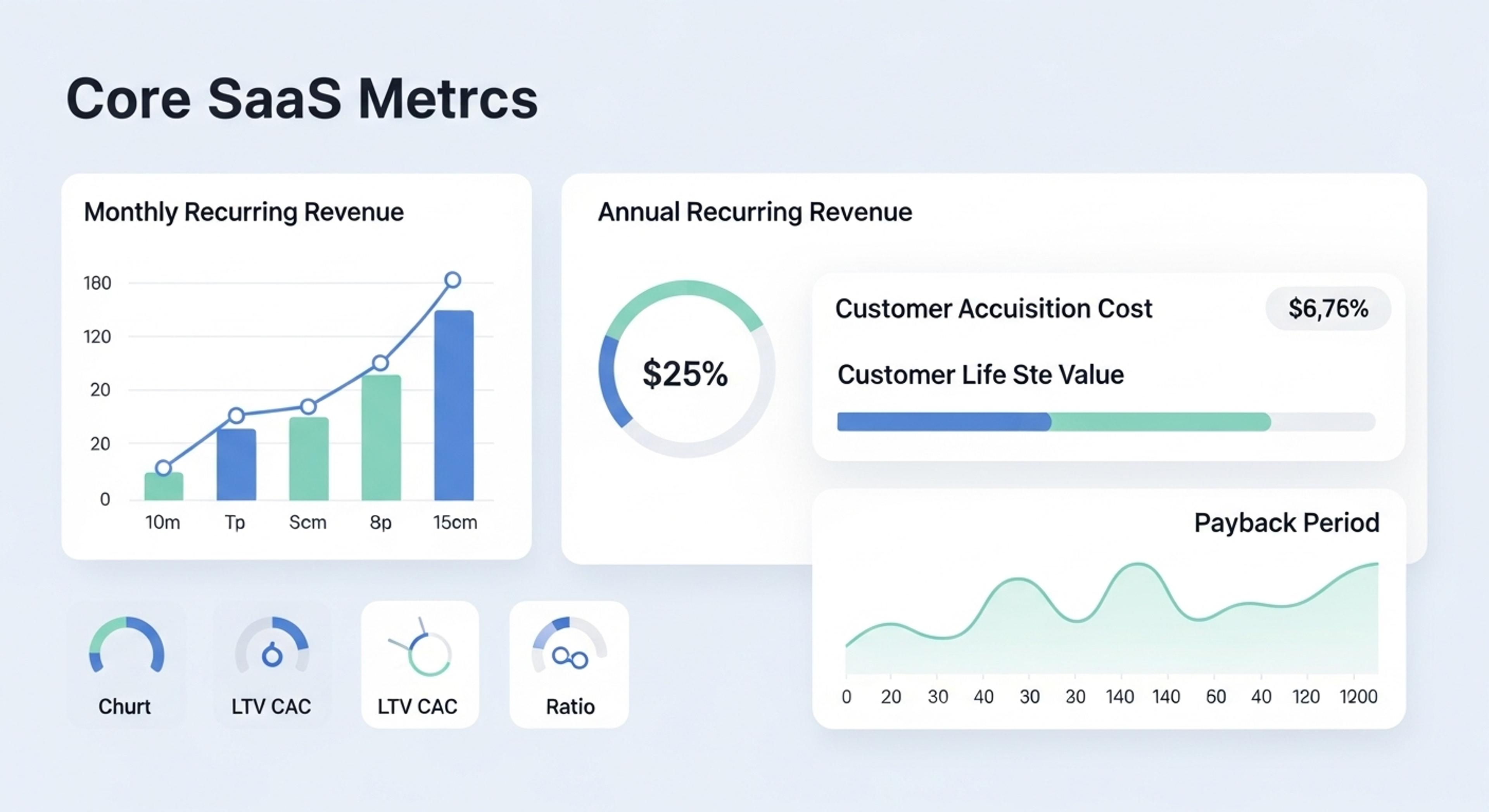
Monthly Recurring Revenue (MRR): The total predictable subscription revenue you collect each month.
Example: 100 customers × $250/month = $25,000 MRR
Track MRR growth religiously. Successful SaaS companies grow MRR by 10-20% monthly in early stages. In mature markets like the US and Australia, achieving $10K MRR within 12 months is a solid benchmark for bootstrapped startups.
Annual Recurring Revenue (ARR): Your MRR multiplied by 12. This is the number investors and acquirers care about most.
Example: $25,000 MRR × 12 = $300,000 ARR
Once you hit $1M ARR, you're positioned for venture capital or acquisition. Many Australian SaaS exits happen between $3-10M ARR, while US exits often occur at $10M+ ARR.
Customer Acquisition Cost (CAC): Total sales and marketing spend divided by new customers acquired.
Example: $10,000 spent on Google Ads and sales → 40 new customers = $250 CAC
In competitive US markets, B2B SaaS CAC ranges from $300-$1,500 depending on your average contract value. Australian markets often see 20-30% lower CAC due to less competition, though market size is smaller.
Customer Lifetime Value (LTV): Total revenue you'll collect from a customer over their entire relationship with your business.
Formula: Average Monthly Revenue per Customer × Average Customer Lifespan (months)
Example: $250/month × 24 months average retention = $6,000 LTV
This is your most important metric. If customers stay longer and pay more, your business becomes exponentially more valuable.
LTV to CAC Ratio: The golden metric that determines business sustainability.
Formula: LTV ÷ CAC
Example: $6,000 LTV ÷ $250 CAC = 24:1 ratio
Benchmarks:
- Below 3:1 = Unsustainable (you're spending too much to acquire customers)
- 3:1 to 5:1 = Healthy, sustainable growth
- Above 5:1 = Excellent, you should invest more in customer acquisition
Churn Rate: Percentage of customers who cancel monthly. This metric can make or break your SaaS business.
Formula: (Customers Lost This Month ÷ Customers at Start of Month) × 100
Example: Lost 5 customers out of 100 at month start = 5% monthly churn
Benchmarks by Market:
- Consumer SaaS: 5-10% monthly churn (acceptable due to lower prices)
- SMB SaaS: 3-7% monthly churn
- Enterprise SaaS: 0.5-2% monthly churn (annual contracts reduce churn)
US and Australian markets: Enterprise customers typically sign annual or multi-year contracts, giving you 0.5-1% monthly churn. SMBs are month-to-month, seeing 3-5% churn.
Why This Matters: At 5% monthly churn, you lose half your customers every 12 months. At 2% churn, customers stay 4+ years on average—dramatically increasing LTV and business value.
Payback Period: How long it takes to recover your customer acquisition cost from their monthly payments.
Formula: CAC ÷ (Monthly Revenue per Customer × Gross Margin)
Example: $250 CAC ÷ ($250 monthly × 75% margin) = 1.3 months
Benchmark: Target 12 months or less. Investors want to see you recovering acquisition costs quickly. US SaaS companies average 10-14 month payback; Australian companies see 8-12 months due to lower CAC.
📊 SaaS Metrics Spreadsheet (FREE RESOURCE)
Track your MRR, ARR, CAC, LTV automatically.
Just enter your data - formulas do the rest.
[DOWNLOAD SPREADSHEET]
Revenue Models: How to Price Your SaaS for Maximum Profit
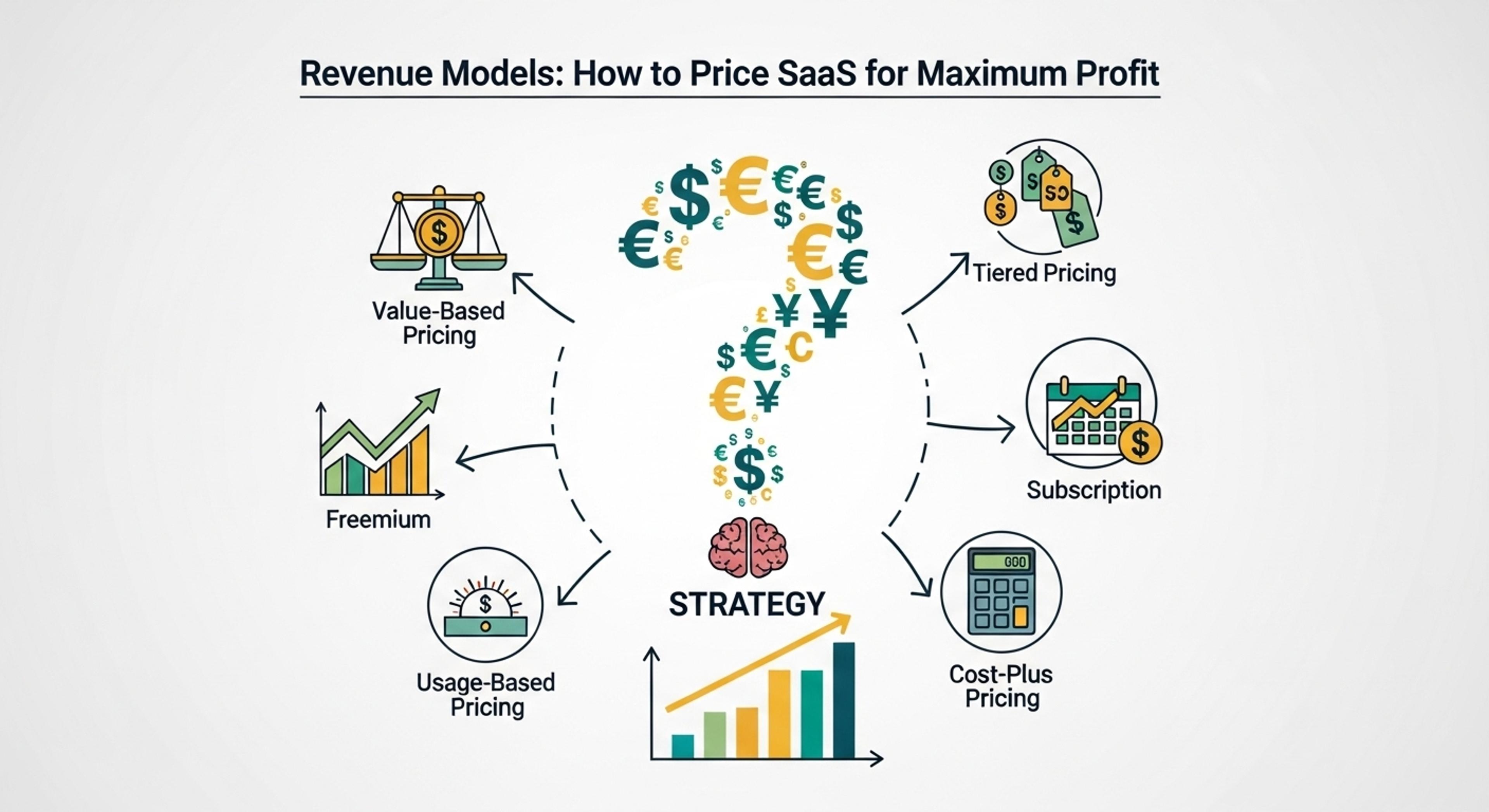
Tiered Subscription Pricing (Most Popular in US and Australia)
Create 3-4 pricing tiers that appeal to different customer segments:
Starter Plan: $49-$149/month
- Core features only
- Individual users or small teams
- Email support
- Appeals to: Freelancers, solo entrepreneurs, small startups
Professional Plan: $149-$499/month
- Advanced features and integrations
- 5-25 users
- Priority support + phone support
- Appeals to: Growing SMBs, small agencies (20-50 employees)
Business Plan: $499-$1,999/month
- All features + premium capabilities
- Unlimited users or 25-100 users
- Dedicated account manager
- Appeals to: Mid-market companies in the US and Australia (100-500 employees)
Enterprise Plan: Custom pricing ($2,000-$50,000+/month)
- Everything + custom development
- Unlimited scale
- SLA guarantees, compliance features
- Single Sign-On (SSO), API access
- Appeals to: Large corporations, government agencies
Pricing Psychology: 60-70% of customers choose the middle tier. Price your "Professional" plan at your target revenue per customer.
Usage-Based/Metered Pricing
Charge based on consumption: API calls, data storage, transactions processed, emails sent.
Examples:
- AWS: Pay per compute hour and data storage
- Twilio: Pay per SMS or phone call
- Stripe: 2.9% + $0.30 per transaction
- SendGrid: Pay per email sent
Best for: Infrastructure tools, communication platforms, payment processing, developer tools
Advantages:
- Fair pricing—customers pay only for what they use
- Scales naturally with customer success (as they grow, they use more, you earn more)
- Lower barrier to entry for small customers
Disadvantages:
- Unpredictable revenue (harder to forecast MRR)
- Complex billing systems required
- Customers may leave due to unexpected bills
Per-Seat/Per-User Pricing
Charge for each person who uses your software.
Example: $29 per user/month
If a company has 10 employees, they pay $290/month. As they hire more people, revenue grows automatically.
Best for:
- Team collaboration tools (Slack, Asana, Monday.com)
- CRM systems (Salesforce, HubSpot)
- Project management software
- Communication platforms
Advantages:
- Revenue grows as customer's team grows
- Easy to understand pricing
- Natural upsell path (add more users = more revenue)
Popular in US and Australian SMB markets: Small businesses understand per-user pricing and find it fair.
Feature-Based Pricing
Different tiers unlock different features or capabilities.
Example:
- Basic: Core features only
- Pro: Core + advanced analytics + integrations
- Premium: Everything + API access + white-labeling
Freemium Model
Offer a free tier with limitations; charge for unlimited access or premium features.
Examples:
- Slack: Free for small teams, paid for message history and integrations
- Dropbox: Free 2GB storage, paid for more space
- Mailchimp: Free up to 500 contacts, paid for more
Conversion Rates: Typically 1-5% of free users convert to paid. This means you need 2,000 free users to get 40-100 paying customers.
Best for:
- Products with viral potential (users invite others)
- Network-effect products (more valuable with more users)
- Low marginal cost to serve free users
Caution: Freemium works best when you have low costs per user. If hosting costs $5/month per free user, you're losing money unless conversion rates are strong.
The Path to SaaS Profitability: What to Expect by Year
Year 1: Focus on product-market fit and customer acquisition, not profit.
Reality check: 90% of successful SaaS companies lose money in Year 1. You're investing in product development and finding the right customers.
Year 2-3: Reach breakeven as your customer base grows and word-of-mouth reduces CAC.
By month 18-24, you should have 100-300 customers and $25,000-$100,000 MRR. CAC decreases as referrals and organic traffic increase. This is when profitability becomes realistic.
Year 3+: Achieve strong profitability with high retention and efficient customer acquisition.
Mature SaaS companies with $1M+ ARR typically see 20-40% profit margins. Every new customer becomes highly profitable once you've recovered initial development costs.
Typical Economics at Scale (US and Australian Markets):
- Gross Margins: 70-85% (SaaS has high margins once developed)
- CAC Payback Period: 12-18 months average
- Monthly Churn Rate: 2-5% for SMB customers; 0.5-2% for enterprise
- LTV:CAC Ratio: 4:1 to 8:1 for successful companies
Realistic Revenue Milestones:
- Month 6: $5,000 MRR (20-50 customers)
- Month 12: $15,000-$25,000 MRR (75-150 customers)
- Month 24: $50,000-$100,000 MRR (250-500 customers)
- Month 36: $150,000-$250,000 MRR (750-1,250 customers)
These benchmarks apply to bootstrapped B2B SaaS companies in competitive US and Australian markets. Consumer SaaS or venture-backed companies may grow faster but require significantly more capital.
Part 3: The Founder Mindset—7 Mental Frameworks for Success
Building a profitable SaaS business in competitive markets like the United States and Australia requires more than technical skills—it demands a specific founder mindset. These mental frameworks separate successful SaaS entrepreneurs from those who build products nobody wants.

1. Customer Obsession: The #1 Success Factor
The Reality: 42% of startups fail because they build products without market need. In high-revenue markets like the US and Australia, customers have countless options. Your product must solve real pain points better than alternatives.
What This Means Practically:
Spend 50% of your time talking to customers, not coding. In the first 6 months, you should conduct 100+ customer conversations.
Make every product decision based on customer feedback, not assumptions. When a customer in Sydney says "I need integration with Xero," and five others agree, that goes on your roadmap. Your opinion about features matters less than customer demand.
Action Steps for US and Australian Markets:
- Customer Interviews: Schedule 20-30 conversations with target customers before building anything. Ask about their current pain points, what they're paying for existing solutions, and what's missing from current tools.
- Customer Advisory Board: Invite 5-10 early customers to monthly video calls. Share your roadmap, gather feedback, and let them influence direction. This builds loyalty and ensures product-market fit.
- Track Satisfaction Metrics: Implement Net Promoter Score (NPS) surveys. Target: 50+ NPS score. Under 30 means customers aren't enthusiastic enough to refer others.
- Daily Support Monitoring: Read every support ticket and customer email daily. Successful founders in competitive markets know exactly what frustrates customers.
Why This Matters: Slack grew to $1 billion valuation by obsessing over customer feedback. Their founder, Stewart Butterfield, spent hours daily reading customer support tickets and feature requests. Australian success story Atlassian built their $50B+ company around customer obsession—everything they build solves real developer problems.
2. Embrace the Long-Term Journey
The Reality: Building a valuable SaaS company takes 3-5 years minimum, often longer. Overnight success stories are rare myths most successful founders worked 60-80 hour weeks for years.
US and Australian Market Context:
In mature markets, competition is fierce. You're competing against well-funded companies with established brands. Success requires sustained effort:
- Year 1: Product development + finding first 50-100 customers
- Year 2: Refining product-market fit + scaling to $250K-$500K ARR
- Year 3: Optimizing growth channels + reaching $1M+ ARR
- Year 4-5: Scaling operations + building to $3M-$10M ARR for exit or sustainability
Mental Preparation:
Progress isn't linear. Some months you'll gain 20 customers; others you'll lose 10 to churn. Revenue might plateau for quarters before breaking through.
Celebrate small wins: Your first paying customer, your first $1,000 MRR month, your first annual contract. These milestones matter psychologically.
Action Steps:
- Set Realistic 3-5 Year Goals: Don't expect $1M ARR in year one unless you're venture-backed. Bootstrapped founders typically need 2-3 years to reach $1M ARR.
- Break Big Goals Into Quarterly Objectives: Q1 goal: 25 customers. Q2 goal: $10K MRR. Q3 goal: 2% monthly churn or less.
- Founder's Journal: Document your journey weekly. Reflect on progress, setbacks, and learnings. This helps maintain perspective during difficult periods.
- Build a Founder Network: Join communities like Indie Hackers, SaaS growth communities in US/Australian cities, or local startup groups. Other founders understand the struggle and provide emotional support.
3. Constraints Drive Innovation
The Reality: Limited budgets force brilliant focus. The best SaaS products solve one problem exceptionally well, not ten problems poorly.
Why Constraints Matter:
Basecamp started as a simple project management tool with limited features—and grew to 50,000+ customers by doing one thing perfectly. Companies that try to be everything to everyone dilute their value proposition.
For Bootstrapped Founders (most US and Australian SaaS founders start this way):
Limited budget ($10,000-$50,000 to start) forces you to:
- Build only essential features (5-7 core capabilities, not 30)
- Target one specific customer segment, not "all businesses"
- Choose one acquisition channel, not five
- Say "no" to 90% of feature requests
Action Steps:
- Strict Feature Budget for MVP: Launch with exactly 5-7 core features. Anything beyond that is "Phase 2."
- Public Roadmap: Use tools like Canny or Trello to let customers vote on features. Build what they prioritize, not what you think is cool.
- One Market Segment Initially: Don't try to serve "all businesses." Start with one niche—e.g., "software development agencies with 10-50 employees in the US" or "e-commerce businesses in Australia using Shopify."
4. Data-Driven Decision Making
The Reality: Gut feeling is wrong 50% of the time. Data reveals truth. Successful founders in competitive markets measure obsessively and let metrics guide decisions.
Critical Metrics to Track From Day One:
- Website Conversion Rate: What % of visitors sign up? Target: 2-5% for B2B SaaS
- Free Trial to Paid Conversion: What % convert after trial? Target: 15-25%
- Monthly Churn Rate: What % cancel monthly? Target: Under 5% for SMB, under 2% for enterprise
- Customer Acquisition Cost (CAC): Track spend-per-customer by channel
- Time to Value: How quickly do customers experience their first "aha moment"?
Action Steps:
- Install Analytics Day One: Use Google Analytics, Mixpanel, or Amplitude to track every user action. Know where users drop off in your signup flow.
- Create a Metrics Dashboard: Build a simple spreadsheet or use tools like Baremetrics (for Stripe) to visualize MRR, churn, CAC, and LTV weekly.
- Run Experiments: Test different pricing ($99/month vs $149/month with 10% of traffic), messaging ("Save 10 hours weekly" vs "Automate your workflow"), or features (does adding X increase retention?).
- Make Data-Based Decisions: Before building a feature, ask: "What data suggests customers need this?" If 40% of support tickets mention it or 25+ customers requested it, build it. If you just think it's cool, don't.
Why This Matters: Stripe famously tracks 100+ metrics and uses data to guide every decision. Australian unicorn Canva measures user engagement obsessively—they know exactly which features drive retention and which don't.
5. Sales Mentality for Technical Founders
The Reality: "If you build it, they will come" is false. The best product doesn't win the best-marketed product wins.
For Technical Founders (common in US and Australian SaaS):
You might be great at coding but uncomfortable with sales. This must change. 50% of your time should focus on customer acquisition, not product development.
What Sales Means for SaaS:
Sales isn't pushy or slimy it's helping customers solve problems. When you genuinely believe your product saves a customer 15 hours weekly or $5,000 monthly, selling becomes education, not manipulation.
Action Steps:
- Learn Sales Fundamentals: Read books like "The Mom Test" by Rob Fitzpatrick or "Predictable Revenue" by Aaron Ross. Understand how to ask questions, handle objections, and close deals.
- Personal Outreach: Spend 10 hours weekly reaching out to potential customers via email, LinkedIn, or industry forums. Share how your tool solves specific problems they've mentioned publicly.
- Study Competitor Messaging: What language do successful competitors use? What pain points do they emphasize? Adapt (don't copy) their approach.
- Track Sales Conversations: Note common objections. If 10 prospects say "I love this but it's too expensive," your pricing is wrong. If they say "This is great but doesn't integrate with X," add that integration.
Don't Hire Salespeople Early: Founders should sell the first 50-100 customers themselves. You need to understand what messaging works, what objections arise, and who your ideal customer actually is before hiring someone to replicate the process.
6. Iterate Fearlessly, Launch Imperfectly
The Reality: Your first version will be wrong. Successful founders launch imperfect products quickly, gather feedback, and iterate weekly.
Why This Matters:
Companies that spend 12-18 months building the "perfect" product often discover customers want something completely different. Those who launch in 3-4 months learn quickly and adapt.
Case Study: Airbnb's first product was a simple website letting people rent air mattresses. It was imperfect, awkward, and limited. But they launched quickly, learned customers wanted full apartments (not just air mattresses), and pivoted. If they'd spent 18 months building the "perfect" air mattress rental platform, they'd have failed.
Action Steps:
- Launch MVP in 3-4 Months: Build only the core 5-7 features customers absolutely need. Everything else is version 2.
- Weekly Release Cadence: Push updates every week, not every quarter. Small, frequent improvements beat massive, infrequent launches.
- Embrace Imperfection: Your first website will have typos. Your first product will have bugs. Launch anyway. Perfect kills momentum.
- Use Feature Flags: Test new features with 10% of users before rolling out to everyone. This minimizes risk while maximizing learning.
Pivoting is Normal:
- Slack started as a gaming company
- Twitter started as Odeo, a podcasting platform
- Instagram started as Burbn, a check-in app
Successful companies pivot 1-3 times based on market feedback. View pivots as learning, not failure.
7. Systems Thinking
The Reality: Every decision affects multiple parts of your business. Changing pricing impacts marketing messages, which affects CAC, which changes your LTV:CAC ratio, which determines profitability.
Example of Systems Thinking:
You decide to add a free trial (instead of paid-only). This affects:
- Conversion Rate: Increases (more people will try for free)
- Quality of Customers: Decreases (free trials attract tire-kickers)
- Churn Rate: Likely increases (less commitment from free trial users)
- Support Load: Increases (more users need help onboarding)
- Cash Flow: Decreases short-term (trial users don't pay immediately)
Understanding these ripple effects helps you make better decisions.
Action Steps:
- Create a Business Model Canvas: Map out how all pieces of your business connect value proposition, customer segments, channels, revenue streams, cost structure.
- Model Your Economics: Build a spreadsheet showing: At $50K MRR, what are my costs? When do I break even? What happens if churn increases by 2%?
- Plan for Scale: What breaks when you have 500 customers? 2,000 customers? Your database? Customer support response times? Know in advance and prepare.
- Consider Technical Debt: Early decisions about technology and architecture compound. Choosing MongoDB instead of PostgreSQL might seem minor now but could cost $100K to fix later when you have 10,000 customers.
Why This Matters: US and Australian SaaS founders who think systemically avoid costly mistakes. They understand that pricing, positioning, product features, and customer support all interconnect—and optimize the entire system, not just individual parts.
Part 4: The 4-Stage SaaS Validation Framework
The #1 Reason SaaS Companies Fail: Building products nobody wants.
42% of startups fail due to lack of market need. In competitive markets like the United States and Australia, validation is mandatory—not optional. You cannot afford to spend 6-12 months building a product customers won't pay for.
Market validation proves that real customers will pay for your solution before you invest significant time and money. This process separates successful SaaS founders from those who build expensive hobbies.
The Complete 4-Stage Validation Process
Stage 1: Problem Discovery & Validation (Week 1-2)
Objective: Confirm the problem is real, significant, and worth solving in your target market.
Target: Complete 20-30 customer interviews with people who match your Ideal Customer Profile (ICP) in the US or Australian markets.
Step 1: Find Your Interview Candidates
Where to Find Potential Customers:
- LinkedIn: Search for job titles in your target industry. Example: "Marketing Manager" + "San Francisco" or "Melbourne" + "50-200 employees"
- Industry Forums: Participate in Reddit communities, Facebook groups, Slack communities where your customers gather
- Local Networking Events: Attend meetups, conferences, or startup events in major US cities (SF, NYC, Austin) or Australian cities (Sydney, Melbourne, Brisbane)
- Cold Outreach: Email 100 prospects with: "I'm researching [problem area] and would love 15 minutes of your time. I'll send you a $20 Starbucks gift card as thanks."
Response Rate: Expect 10-20% response rate. Send 150 outreach messages to get 20-30 interviews.
Step 2: Conduct Problem-Focused Interviews
Critical Rule: Never describe your solution. Only ask about their problems.
What You're Listening For:
Red Flags (Stop or Pivot):
- Less than 70% of interviewees acknowledge this is a significant problem
- Urgency ratings below 6/10 consistently
- Nobody currently spends money trying to solve this
- Responses like: "It's annoying but we've accepted it" or "It's not really costing us much"
Green Flags (Continue):
- 80%+ immediately recognize and feel frustrated by the problem
- Urgency ratings of 7+/10
- They're already paying for imperfect solutions
- Emotional responses: "This is killing our productivity" or "We're losing thousands per month on this"
- Immediate interest: "When will this be ready? We need it now."
Step 3: Analyze Competitors and Existing Solutions
Don't fear competition lack of competition is often worse. If nobody else is solving this problem, question whether it's real or profitable.
Competitive Analysis Steps:
- Google Search: Search "[problem] software" or "[problem] tool"
- Review Sites: Check G2, Capterra, TrustRadius for competitors
- Document 5-10 Competitors or Alternatives:
- Company name and website
- Pricing (what do they charge?)
- Key features (what do they offer?)
- Customer reviews (what do users love? hate?)
- Gaps and opportunities (what's missing?)
- Pricing Research: If competitors charge $99-$299/month, customers clearly pay for solutions. This validates the market.
- Review Analysis: Read 50+ reviews on G2 or Capterra. Look for common complaints these are your opportunities:
- "The interface is clunky and outdated"
- "Customer support is terrible"
- "It's too expensive for what it does"
- "Missing integration with [important tool]"
Example Findings:
Problem: Small agencies struggle with client time tracking
Competitors: Harvest ($12/user/month), Toggl ($10/user/month), Clockify (freemium)
Common Complaints: "Too complex," "Poor reporting," "No client portal," "Doesn't integrate with QuickBooks"
Opportunity: Build a simple time tracking tool with excellent reporting and QuickBooks integration specifically for agencies.
Stage 2: Value Validation (Week 3-4)
Objective: Confirm that people will pay for YOUR specific solution approach not just any solution.
Step 1: Create a Simple Landing Page (No Product Needed)
Purpose: Test whether your positioning and messaging resonate with your target market.
Step 2: Drive Targeted Traffic to Your Landing Page
Method 1—Paid Ads (Recommended for Fast Learning):
Run $300-$500 in Facebook or Google Ads targeting your exact ICP.
Google Ads Setup:
- Target keywords: "[problem] software," "[problem] solution," "[industry] tools"
- Geographic targeting: Major US cities (San Francisco, New York, Austin, Seattle) or Australian cities (Sydney, Melbourne, Brisbane)
- Budget: $20-30/day for 2 weeks
- Track: Cost per click (CPC) and conversion rate to email signup
Facebook/LinkedIn Ads Setup:
- Target: Job titles, company sizes, industries that match your ICP
- Ad copy: Focus on the problem, not your solution
- Example: "Spending 15+ hours weekly on manual reporting? There's a better way. Join our early access list."
- Budget: $25/day for 2 weeks
Success Metrics:
- Target Conversion Rate: 3-5% of visitors sign up for early access
- Red Flag: Less than 1% conversion = messaging problem or weak value proposition
- Green Flag: 5%+ conversion = strong market interest
Method 2—Organic Outreach (Better for B2B):
Email or LinkedIn message 100 people from your Stage 1 interviews:
Subject: Quick question about [problem]
"Hi [Name],
We spoke a few weeks ago about [problem]. I'm building a solution and wanted to share an early preview.
Would you be interested in seeing what we're working on?
[Link to landing page]
Thanks,
[Your name]"
Expected Response: 10-20% will visit your page; 5-10% will sign up for updates.
Step 3: Conduct "Willingness to Pay" Research
Purpose: Determine optimal pricing before building anything.
Survey Method:
Create a Google Form or Typeform with these questions:
Distribution: Send to your 50+ landing page signups and interview contacts.
Analysis:
Look at where 40-50% of respondents cluster. That's your initial pricing sweet spot.
Example Results:
- 65% would pay $49-99/month
- 45% would pay $99-199/month
- 30% would pay $199-499/month
- 15% would pay $499+/month
Pricing Decision: Start at $149/month (where 45% still say yes). This maximizes revenue while maintaining reasonable conversion rates.
US vs Australian Pricing:
- US customers typically accept 20-30% higher pricing for SaaS tools
- Australian customers expect similar USD pricing but want invoicing in AUD
- Consider separate pricing pages: "$149 USD" for US, "$199 AUD" for Australia
Step 4: Pre-Sales and Letters of Intent
The Ultimate Validation: Getting customers to commit money before you build anything.
Pre-Sales Approach:
Email 50 people who showed strong interest (clicked your landing page, responded positively to outreach):
Subject: Early Access to [Product] - Limited Spots
"Hi [Name],
I'm pre-launching [Product Name] to solve [problem] for [target customer].
I'm looking for 10 early customers who will:
Get lifetime 30% discount ($99/month instead of $149/month)Receive priority support and feature requestsHelp shape the product roadmapGet first access (launching in [X weeks])
In exchange, I need your commitment to:
Use the product for at least 3 monthsProvide weekly feedback during the first monthParticipate in one 30-minute interview monthly
Interested in a 15-minute call to discuss?
Best, [Your name]"
Success Metric:
- Target: 10% response rate (5-10 people interested)
- Red Flag: Less than 5% interest = value proposition isn't strong enough
- Green Flag: 15%+ interest = strong product-market fit signals
Letter of Intent Template:
Once someone expresses interest, send this:
Letter of Intent - Early Access Program
"Thank you for your interest in [Product]!
Here's what early access includes:
Launch date: [Expected date]Pricing: $99/month (normally $149/month) - locked in foreverTerms: Month-to-month, cancel anytime after 3 monthsSupport: Direct access to me via email and Slack
To secure your spot, please reply to this email confirming:
You're interested in early accessYou'll commit to 3 months minimumYou'll provide feedback weekly in Month 1
No payment required now—I'll invoice you when we launch.
Looking forward to working together!
[Your name]"
Why This Works:
Real commitment without upfront payment validates market demand. If 10 people commit to paying $99/month, that's $990 MRR before you've built anything—clear proof you should proceed.
Real-World Benchmark:
Successful B2B SaaS founders in the US and Australia typically secure 5-15 LOI commitments before writing significant code. If you can't get 5 people to commit, your validation is incomplete.
Stage 3: Solution Validation (Week 5-12)
Objective: Confirm that your specific solution approach solves the problem better than alternatives.
Step 1: Create Low-Fidelity Mockups
Do NOT build the actual product yet. Design mockups showing how your solution works.
Tools to Use:
- Figma (free, professional-grade)
- Adobe XD (free tier available)
- Balsamiq (quick wireframes)
- Even hand-drawn sketches photographed
What to Create:
10-15 key screens showing:
- Onboarding flow: How does a new customer get started?
- Core workflow: How does the customer solve their main problem?
- Key features: What are the 5-7 essential capabilities?
- Dashboard/overview: What do they see when they log in?
Time Investment: 30-40 hours of design work
Quality Level: Make it realistic enough to evaluate but simple enough to change easily. Don't obsess over colors or fonts—focus on functionality and workflow.
Pro Tip: Use UI kit templates from Figma Community to speed up the process. Search for "SaaS dashboard template" or "[your industry] UI kit."
Step 2: Smoke Test with Potential Customers
Process:
Schedule 30-minute video calls with 10-15 people from your Stage 1 and Stage 2 validation (people who showed strong interest).
Record Every Session (with permission) so you can review feedback later.
Success Criteria:
- Green Light: 80%+ say "yes, this would solve our problem"
- Yellow Flag: 60-79% positive but with significant feature requests = iterate and re-test
- Red Flag: Less than 60% enthusiastic = your solution approach is wrong, pivot
What to Listen For:
Positive Signals:
- "This is exactly what we need"
- "When can we start using this?"
- "This would save us so much time"
- Customers imagining specific use cases: "We'd use this for X, Y, and Z"
Warning Signals:
- "Interesting, but we'd use it differently"
- "Can you add [massive feature list]?" = solution doesn't match their needs
- Long pauses or confusion when you show key workflows
- "I'd have to check with my team" (indicates low personal urgency)
Step 3: Iterate Based on Feedback
Expected Outcome: Your first mockup will be wrong in some ways. That's normal.
Common Feedback Patterns to Watch For:
If 3+ people mention the same missing feature, add it to your MVP. If 5+ people mention it, it's essential. If people consistently struggle to understand a workflow, simplify it. Complexity kills SaaS adoption. If multiple people suggest a different approach to a core feature, listen—they know their workflows better than you do.
Iteration Cycle:
- Show mockups to 5 people
- Identify common feedback themes
- Update mockups (1-2 days of work)
- Show revised mockups to next 5 people
- Repeat until 80%+ say "this is what we need"
Typical Timeline: 2-3 iteration cycles over 4-6 weeks
Step 4: Create a Customer Advisory Board
Purpose: Build a group of 5-10 engaged customers who influence your roadmap and become your biggest advocates.
How to Form Your Advisory Board:
Invite the most enthusiastic people from your validation process:
Email Template:
"Hi [Name],
Your feedback has been incredibly valuable in shaping [Product]. I'd like to invite you to join our Customer Advisory Board.
This means:
Monthly 30-minute video calls to review progress and prioritize featuresEarly access to new features before anyone elseLifetime 40% discount as a thank you for your inputDirect influence on our roadmap
Interested? Our first call is [date].
Thanks,
[Your name]"
Advisory Board Benefits:
For You:
- Continuous validation throughout development
- Direct feedback loop with ideal customers
- Built-in evangelists who refer others
- Reduced risk of building wrong features
For Them:
- Shape a tool that perfectly fits their needs
- Recognition and relationship with founders
- Significant pricing discount
- Early competitive advantage in their market
Meeting Structure (Monthly, 30-45 minutes):
- Progress Update (10 minutes): Show what you built this month
- Feedback Session (15 minutes): What's working? What's not?
- Roadmap Discussion (15 minutes): Vote on next priorities
- Open Discussion (5 minutes): Any other concerns or ideas?
Real-World Success Story:
Intercom, a major SaaS company now valued at $1B+, formed a customer advisory board of 10 companies during their early stages. These customers influenced every major feature decision and became their largest accounts—some paying $50K+ annually.
Stage 4: Business Model Validation (Week 8-12)
Objective: Confirm customers will pay your planned price and retain long enough for profitability.
Step 1: Validate Pricing Through Direct Conversations
Return to your customer advisory board and other enthusiastic prospects for pricing discussions.
Conversation Framework:
"Based on what you've seen, I want to validate our pricing approach. I'm considering three tiers:
Starter: $79/month - [Features 1-3]
Professional: $179/month - [Features 1-5]
Business: $399/month - [All features + priority support]
Questions:
- Which tier would your company choose?
- Does this pricing feel fair for the value delivered?
- Would you prefer monthly or annual billing?
- At what price point would this become too expensive?"
Success Criteria:
- 60%+ comfortable with Professional tier pricing ($179/month in this example)
- Less than 20% say "too expensive" at your target price
- Pricing consistency across customer interviews (they cluster around same tier)
US vs Australian Market Considerations:
US Market:
- Higher willingness to pay for cutting-edge features
- Expect self-service onboarding and minimal support
- Comfortable with higher price points ($199-$499/month for SMB tools)
Australian Market:
- Value reliability and responsive support
- Prefer talking to real people during onboarding
- Slightly lower price sensitivity but expect excellent value ($149-$399/month for SMB tools)
Step 2: Test Different Pricing Models
Run a small experiment with your landing page traffic or advisory board:
A/B Test Pricing Presentation:
- Version A: Per-user pricing "$39 per user/month"
- Version B: Flat rate pricing "$179/month for up to 10 users"
- Version C: Usage-based pricing "$99/month + $0.10 per transaction"
Measure: Which version gets more email signups or demo requests?
Common Findings in B2B SaaS:
- Per-user pricing works best for collaboration tools (Slack, project management)
- Flat rate pricing works best when customer can't predict user count or wants budget predictability
- Usage-based pricing works best for developer tools, APIs, and infrastructure services
Step 3: Pre-Launch Paid Pilot
The Ultimate Validation: Get 5-10 customers to pay for your product before it's fully built.
How to Structure a Paid Pilot:
Reach out to your advisory board and LOI customers:
Email:
"Hi [Name],
We're launching [Product] in 6 weeks. I'd like to invite you to our paid pilot program.
What you get:
Early access starting [date]Founding member pricing: $99/month (50% off) locked in foreverWhite-glove onboarding - I'll personally set you upWeekly check-ins during Month 1Direct influence on features
What we need:
Payment of $99/month starting [launch date]Commitment to 3-month minimumCandid feedback on what's working/not workingOne 30-minute feedback call monthly
Interested? I'll send an invoice once you confirm.
Thanks,
[Your name]"
Success Metrics:
- Green Light: 5-10 customers agree to pay (even at discounted rate)
- Yellow Flag: 2-4 customers agree = may need to adjust pricing or positioning
- Red Flag: 0-1 customers agree = serious problem with value proposition or price
Why This Matters:
Real payment = real commitment. People who pay attention differently than people who get free trials. Paid pilot customers are serious about using your product and will provide higher-quality feedback.
Stripe famously did this: They manually processed payments for their first customers before the product was fully automated. This validated that companies would actually pay for payment processing software.
Step 4: Calculate Customer Lifetime and Churn Assumptions
Critical Question: How long will customers stay?
Research Method:
Ask your pilot customers and advisory board:
"Assuming this product works as expected:
- Would you use it for 3 months? 6 months? 12 months? 24+ months?
- What would cause you to cancel?
- What would make you a customer for years?"
Calculate Estimated LTV:
Scenario 1 - Conservative:
- Average customer stays 18 months
- Monthly price: $149/month
- LTV = 18 months × $149 = $2,682
Scenario 2 - Realistic:
- Average customer stays 24 months
- Monthly price: $149/month
- LTV = 24 months × $149 = $3,576
Scenario 3 - Optimistic:
- Average customer stays 36+ months
- Monthly price: $149/month
- LTV = 36 months × $149 = $5,364
Compare to CAC:
If your estimated CAC is $400 (from ad spend and sales time):
- Conservative LTV:CAC = 6.7:1 ✓ Excellent
- Realistic LTV:CAC = 8.9:1 ✓ Outstanding
- Optimistic LTV:CAC = 13.4:1 ✓ Exceptional
All three scenarios are profitable. You're ready to build.
Red Flags:
- Customers expect to use it for less than 12 months
- High uncertainty about retention ("I'm not sure we'd keep it")
- LTV:CAC ratio below 3:1
- Customers see this as a one-time project tool, not ongoing software
Your Path to SaaS Success: Expected Milestones by Year
Building a successful SaaS business in competitive markets like the United States and Australia is achievable—but only with disciplined validation, clear strategy, and relentless execution.
The Reality Check
- 42% of startups fail due to building products nobody wants
- 90% of SaaS companies lose money in Year 1
- Average time to $1M ARR: 2-3 years for bootstrapped companies
- Success rate improves dramatically with proper validation
Your Competitive Advantages
US Market:
- $130B+ annual SaaS spending
- High willingness to pay for innovation
- Extensive marketing channels
- Large addressable markets
Australian Market:
- 25% YoY growth in SaaS adoption
- Less competition than US
- Strong demand for local solutions
- Government support programs (R&D tax incentives, grants)
The Proven Path Forward
Months 1-3: Validation Phase
- Complete 20-30 customer interviews
- Build landing page and test messaging
- Validate pricing with real prospects
- Secure 5-10 letters of intent
- Create low-fidelity mockups
- Investment: $2,000-5,000 (tools, ads, time)
Months 4-6: Build Phase
- Develop MVP (5-7 core features only)
- Beta test with advisory board
- Iterate based on feedback
- Launch to first 10-20 paying customers
- Investment: $10,000-30,000 (development, hosting)
Months 7-12: Growth Phase
- Refine product-market fit
- Scale primary acquisition channel
- Reach 50-100 customers
- Target: $10K-25K MRR
- Investment: $20,000-50,000 (marketing, hires)
Months 13-24: Scale Phase
- Optimize unit economics
- Add secondary acquisition channels
- Build small team (2-5 people)
- Target: $50K-100K MRR
- Consider funding (optional)
Year 3+: Maturity Phase
- Achieve profitability
- Scale to $200K+ MRR
- Decision point: Bootstrap to exit, raise VC, or build lifestyle business
What Separates Winners from Failures
Successful SaaS Founders:
- Spend 6-8 weeks validating before building
- Talk to 50+ potential customers before launch
- Launch imperfect MVPs in 3-4 months
- Iterate weekly based on customer feedback
- Focus obsessively on one customer segment
- Master one acquisition channel before adding others
- Track metrics daily and adjust quickly
- Stay committed through 2-3 years of hard work
Failed SaaS Founders:
- Build for 6-12 months without customer validation
- Assume they know what customers want
- Try to perfect the product before launching
- Target "all businesses" instead of specific ICP
- Attempt multiple marketing channels simultaneously
- Ignore metrics and make decisions on feelings
- Give up after 6-12 months when growth is slow
The Biggest Mistakes to Avoid
Mistake #1: Building Without Validation The Fix: Talk to 20-30 customers, get 5-10 LOIs, validate pricing before coding.
Mistake #2: Trying to Serve Everyone The Fix: Define specific ICP. Better to dominate one niche than be mediocre everywhere.
Mistake #3: Perfectionism The Fix: Launch MVP with 5-7 features in 3-4 months. Perfect is the enemy of done.
Mistake #4: Ignoring Unit Economics The Fix: Model CAC, LTV, churn from day one. Know your break-even point.
Mistake #5: Doing All Marketing Channels The Fix: Master ONE channel (content, ads, or sales) before adding others.
Mistake #6: Underpricing The Fix: Most founders price too low. If 90%+ say yes to your price, you're leaving money on the table. Target: 40-60% say yes at your price point.
Mistake #7: Hiring Too Early The Fix: Founders should do sales, support, and product for first 50-100 customers. Learn the business before delegating.
Market-Specific Strategies for US and Australian Founders
For US-Based Founders:
Advantages to Leverage:
- Massive addressable market (32M+ businesses)
- High willingness to pay for innovation
- Extensive VC funding available
- Strong startup ecosystem and resources
Challenges to Navigate:
- Intense competition in most categories
- High CAC due to competitive ad markets
- Customers expect self-service and polish
- Faster pace—need to move quickly
Winning Strategy:
- Differentiate through vertical specialization (e.g., "CRM for dental practices" vs "CRM for all businesses")
- Invest in content marketing early—SEO takes 12 months but pays long-term dividends
- Consider remote global teams to reduce costs
- Price confidently—US customers pay premium for quality
For Australian-Based Founders:
Advantages to Leverage:
- Less competition than US market
- Government support (R&D tax incentives, ESVCLP)
- Strong demand for local solutions
- Easier to build personal relationships with customers
Challenges to Navigate:
- Smaller total addressable market
- Limited VC funding compared to US
- Need to consider global expansion earlier
- Customers more price-sensitive
Winning Strategy:
- Build for Australia, scale to US/UK/Canada
- Emphasize local support and data sovereignty
- Bootstrap to $1M ARR before raising (higher valuations)
- Partner with established Australian platforms (Xero, MYOB, Seek)
- Consider dual pricing: AUD for Australia, USD for international
Key Success Metrics by Timeline
Month 3 Benchmarks:
- 10-25 paying customers
- $2,000-$5,000 MRR
- 5-10% monthly churn
- 50+ conversations with prospects
- Clear understanding of ideal customer
Month 6 Benchmarks:
- 30-75 paying customers
- $7,000-$15,000 MRR
- 3-7% monthly churn
- One acquisition channel working consistently
- Net Promoter Score: 30+
Month 12 Benchmarks:
- 100-200 paying customers
- $20,000-$40,000 MRR
- 2-5% monthly churn
- CAC payback under 18 months
- Net Promoter Score: 40+
- First referral customers coming in
Month 24 Benchmarks:
- 300-600 paying customers
- $60,000-$120,000 MRR
- 2-4% monthly churn
- CAC payback under 12 months
- LTV:CAC ratio: 4:1 or better
- 20-30% revenue from referrals
The Mental Game: Preparing for the Journey
Year 1 Reality:
- You'll work 60-80 hour weeks
- You'll question your decision monthly
- You'll face rejection from customers, investors, and partners
- You'll have weeks where MRR drops instead of grows
- You'll feel lonely—most people won't understand what you're building
How to Stay Motivated:
- Track Small Wins: Celebrate every customer, every $1K MRR milestone, every positive review. Progress compounds.
- Build a Founder Network: Join communities (Indie Hackers, local startup groups). Talk to other founders monthly. They understand the struggle.
- Maintain Perspective: Jeff Bezos started Amazon at 30, Reid Hoffman started LinkedIn at 35. Airbnb took 3 years to reach $1M revenue. Success takes time.
- Protect Your Health: Exercise 3x weekly, sleep 7+ hours, maintain relationships. Burnout kills more startups than bad ideas.
- Remember Your Why: Write down why you're building this. Read it when things get hard. Your future customers need your solution.
Resources to Accelerate Your Success
Essential Reading:
- "The Mom Test" by Rob Fitzpatrick (customer validation)
- "Traction" by Gabriel Weinberg (customer acquisition channels)
- "Predictable Revenue" by Aaron Ross (B2B sales)
- "Obviously Awesome" by April Dunford (positioning)
Tools Worth Using:
- Analytics: Mixpanel or Amplitude (free tier)
- Payments: Stripe (2.9% + $0.30 per transaction)
- Email Marketing: SendGrid or Mailchimp (free tier)
- Customer Support: Intercom or Help Scout
- Landing Pages: Carrd or Webflow
- Design: Figma (free)
Communities to Join:
- Indie Hackers (global indie founders)
- SaaS Growth Hacks (tactics and strategies)
- r/SaaS (Reddit community)
- Local startup meetups in your city
US-Specific:
- Y Combinator Startup School (free online course)
- Stripe Atlas (business formation and resources)
- SaaStr Annual conference (largest SaaS event)
Australia-Specific:
- Startmate (accelerator and community)
- SBE Australia (Small Business Festival)
- SaaStock Remote (SaaS conference)
The Truth About SaaS Success
It's not about:
- Having the best idea
- Being the best coder
- Having the most funding
- Being first to market
- Having a perfect product
It's about:
- Solving real problems better than alternatives
- Understanding your customers deeply
- Iterating quickly based on feedback
- Staying committed for 2-3+ years
- Making data-driven decisions
- Being resourceful with constraints
Final Words of Encouragement
Right now, there are hundreds of successful SaaS founders in the United States and Australia who started exactly where you are—with an idea and uncertainty.
They faced the same doubts:
- "Is this problem big enough?"
- "Can I really compete with established players?"
- "Do I have the skills to do this?"
- "What if I spend a year and fail?"
Here's what they learned:
The biggest risk isn't failure it's spending years wondering "what if?"
The best SaaS businesses weren't built by the smartest founders or the best coders. They were built by founders who:
- Validated obsessively before building
- Launched imperfect MVPs quickly
- Listened to customers more than their own assumptions
- Persisted through the inevitable valleys
- Focused on solving real problems, not building cool technology
You don't need:
- A computer science degree (many successful founders are self-taught)
- $100K in the bank (you can validate for under $5,000)
- Previous startup experience (everyone starts somewhere)
- A revolutionary idea (most successful SaaS solves boring problems better)
You do need:
- Willingness to talk to 50+ potential customers
- Commitment to 2-3 years of focused work
- Ability to iterate based on feedback
- Discipline to follow the validation process
- Belief that you can solve a problem people face
The Market is Waiting
The global SaaS market will reach $300B+ by 2027. The US market will account for $150B+. Australia's SaaS sector continues growing at 25% annually.
Within that massive market, there are thousands of underserved niches—specific industries, company sizes, and use cases where existing solutions fall short.
Your opportunity isn't to build the next Salesforce or Shopify.
Your opportunity is to:
- Identify a specific customer segment being underserved
- Understand their problems better than anyone else
- Build a solution that solves those problems 10x better than alternatives
- Acquire customers profitably
- Deliver exceptional value consistently
One Year From Now
Imagine it's January 2027.
Scenario 1: You spent a year thinking about your SaaS idea but never started. You're still wondering "what if?" and wishing you'd begun.
Scenario 2: You spent a year building in isolation without customer validation. You have a product nobody wants. You're burned out and discouraged.
Scenario 3: You followed this guide. You validated thoroughly, built an MVP, launched to 50-100 customers, and are generating $10K-25K MRR. You have real customers who pay you monthly because you solve real problems. You're on the path to building a valuable, profitable business.
Which scenario do you want?
Start Today
You've read 15,000+ words about how to build a SaaS business. You understand validation, metrics, pricing, and go-to-market strategies.
Now you have a choice:
- Close this tab and return to your current situation
- Bookmark this guide and "come back to it later" (you probably won't)
- Take the first action right now
Here's your first action (takes 30 minutes):
Open a Google Doc or Notion page. Title it "[Your SaaS Idea] - Customer Research."
Write down:
- Problem you think you can solve: [One sentence]
- Who experiences this problem: [Your ICP - be specific]
- Why this problem matters: [Time/money wasted, frustration caused]
- 10 people you can interview this week: [List names or where to find them]
- Your commitment: "I will talk to 20 people before building anything."
Then reach out to the first person on your list. Today.
That's it. That's how you start.
Not by building. Not by incorporating an LLC. Not by designing logos.
By talking to people who might have the problem you want to solve.
Welcome to the Journey
Building a SaaS business is one of the most rewarding challenges you'll ever undertake.
You'll create something valuable. You'll solve real problems for real people. You'll build a business that generates recurring revenue while you sleep. You'll join a global community of founders building the future of software.
The path is clear. The validation framework works. The market is massive and growing.
Now it's your turn.
Your SaaS success story starts with one customer interview.
Who will you talk to first?
Share this guide with aspiring SaaS founders. The more people who build validated, customer-focused products, the better the software ecosystem becomes for everyone.
About the writer

Writer
Imesha is a Software and EdTech Specialist for EveryTuesdays. She covers software and mobile development, artificial intelligence, personal development, book reviews, and actionable digital learning guides to help readers upskill.
You May Also Like
Browse All
No-Code + AI: How Indie Hackers Are Building Apps With Bubble, Lovable & GPT in 2026
AI has supercharged no-code. Discover how indie hackers are combining Bubble, Lovable, and GPT-4 to build smarter apps faster and the tools making it possible in 2026.

How to Monetize a No-Code App: Pricing, Payments & Getting to $1K MRR
Built your no-code app now make it profitable. The complete monetization guide for indie hackers: pricing models, Stripe setup, conversion tactics, and reaching $1K MRR.

How to Validate a No-Code App Idea Before Building Anything (The 2-Week Method)
Stop building apps nobody wants. This 2-week validation method helps indie hackers confirm real demand, find paying customers, and avoid the #1 no-code startup mistake.