How to Validate a No-Code App Idea Before Building Anything (The 2-Week Method)
Stop building apps nobody wants. This 2-week validation method helps indie hackers confirm real demand, find paying customers, and avoid the #1 no-code startup mistake.
How to Validate a No-Code App Idea Before Building Anything (The 2-Week Method)
Here is the most expensive mistake you can make as a no-code indie founder: spending six weeks building an app that nobody wanted. And here is the second most expensive mistake: spending those same six weeks building an app that people wanted but would not pay for. Both outcomes feel identical from the outside — a working product with no customers — but they are both entirely preventable.
The no-code community has a build-first culture. Tools like Bubble, Glide, and FlutterFlow have made building so fast and accessible that the temptation to skip validation and just start building is overwhelming. This approach works occasionally and fails most of the time.
The founders who build successful no-code products do something different. They spend two weeks validating their idea before they open their no-code tool of choice. Two weeks. Not two months of market research — two focused weeks of talking to real people, testing real demand, and confirming real willingness to pay. This guide is your complete 2-week validation playbook.
Once validated, move straight to our 30-day no-code Micro-SaaS build guide to execute your build with confidence.
Why Validation Matters More in No-Code Than Traditional Development
In traditional software development, validation is emphasized because building is expensive. In no-code development, the math appears different. Building is cheap and fast. So why validate?
Because the cost of building the wrong thing in no-code is not measured in development expense — it is measured in the opportunity cost of your time and the psychological cost of investing in something that fails. More importantly, the build-fast culture can lull you into iterating endlessly on a product that has a fundamental market problem, not a feature problem. No amount of iteration fixes wrong.
Validation in no-code is about confirming three things before you invest even a single hour in your tool:
- A specific group of people have the problem you're solving
- They experience it frequently enough to justify a paid solution
- They will actually exchange money for your solution — not just say they would if asked
Week 1, Days 1–2: Define the Problem and the Customer
Validation starts with precision. Before you talk to a single potential customer, write your problem statement in one sentence. Not a product description — a problem description.
- ❌ Product description: "A CRM app for small businesses"
- ✅ Problem statement: "Solo real estate agents lose 30% of warm leads because they have no system for consistent follow-up after initial consultations"
The problem statement opens doors. It lets you interview potential customers without biasing them toward your solution.
Alongside your problem statement, write your ICP (Ideal Customer Profile) in three dimensions:
- Who they are (job title, company size, industry or lifestyle)
- What they currently do about this problem (existing workarounds)
- What they value (speed, cost savings, simplicity, status)
For a no-code indie product, your ICP should be narrow enough that you can find 20 real people who fit it within a week. "All small business owners" is not an ICP. "Solo real estate agents in the US managing their own client pipeline" is an ICP.
Week 1, Days 3–5: The 10-Conversation Sprint
Your goal for Days 3–5 is to have 10 genuine conversations with people who match your ICP. Not 10 survey responses — 10 real conversations, ideally video calls, where you listen far more than you speak.
Where to find these people in the US in 2025:
- LinkedIn (search by job title, personalized connection request + gift card offer)
- Facebook Groups and Reddit communities for consumer app ideas
- Indie Hackers forum and relevant Slack communities for founder-facing products
In each conversation, follow the Mom Test methodology — ask about the past, not the future:
- "Tell me about the last time you had to deal with [problem]. What did you do? How long did it take?"
- "What have you already tried to solve this?"
- Never ask: "Would you use an app that solved this?" — people say yes to hypothetical tools constantly and then don't buy.
After 10 conversations, look for patterns:
- 7+ people described the same frustration in similar language → confirmed pain
- 5+ people mentioned spending money on a workaround → monetization validation
- Blank stares or "it's not really that bad" → pivot signal
Week 1, Days 6–7: The Landing Page Test
Conversations validate the problem. Your landing page tests the solution and measures demand.
Build a one-page website in under 4 hours using Carrd ($19/year), a Notion page, or a basic Webflow template. Your landing page needs four elements:
- A headline that names the ICP and describes the outcome they get (not the features you offer)
- Three bullet points that translate features into benefits
- A CTA that captures email sign-ups for a waitlist
- A pricing preview that lets you gauge price sensitivity
Then drive targeted traffic: post in 2–3 communities where your ICP spends time, send to your 10 interview participants, and run a small Google Ads experiment ($30–$50).
The conversion metric that matters: 10%+ of visitors sign up for your waitlist = strong demand signal. 3+ people pay a deposit = very strong signal.
Understanding the competitive landscape directly informs which no-code tool you should build on. See The Best No-Code App Builders to match your product type to the right platform.
Week 2, Days 8–10: Competitive Analysis and Positioning
Search for every existing tool that solves or partially solves your problem. Review each on G2, Capterra, and the App Store. Read the one-star and two-star reviews first — these are your product roadmap, written by your future customers.
The gaps in your competitors' reviews are your positioning. Write one positioning sentence:
"For [ICP], [Your Product] is the [category] that [differentiation] unlike [alternative which does something worse]."
If every competing tool is reviewed as "too complex for non-technical users," your positioning is "the simplest tool in this category."
Week 2, Days 11–12: The Pre-Sale Test
This is the ultimate validation test, and the one most indie founders skip because it requires the most courage: sell your product before it exists.
Create a Stripe payment link or a Gumroad page. Offer early access at a founding member discount — typically 40–50% off your planned launch price — in exchange for paying now. Explain honestly that you are building the product and they will receive early access when it launches.
If 5–10 people pay a real deposit for a product that does not exist yet, you have the strongest possible market validation. You also have early customers who are invested in your success.
Most first-time no-code founders skip pre-sales because they fear rejection. But rejection at this stage costs you nothing except time. Rejection at the end of a 6-week build costs you 6 weeks.
Week 2, Days 13–14: Build / No-Build Decision
Score your idea against this validation scorecard:
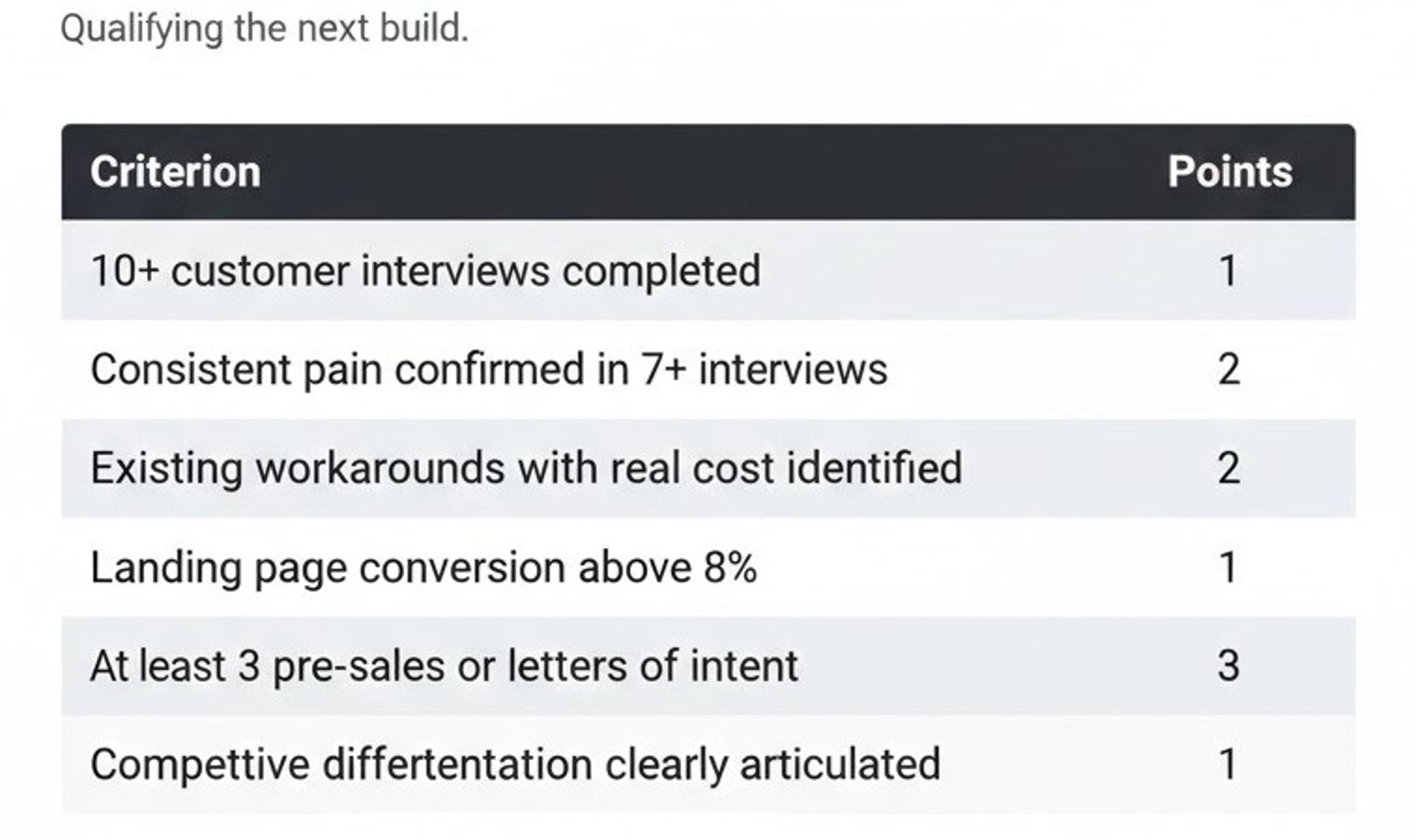
- Score 7+: Build
- Score 5–6: Pivot your positioning and re-test
- Score below 5: Pivot your idea
Common Validation Mistakes No-Code Founders Make
Validating with friends and family. Your network wants you to succeed and will tell you your idea is great. Their opinion is affection, not market signal.
Asking "would you use this?" instead of "what have you done about this?" The first question asks people to predict their future behavior — a task humans are notoriously bad at. The second asks about actual past behavior, which reliably predicts future behavior.
Treating survey data as equivalent to conversation data. Surveys confirm patterns you've already found. Conversations reveal what you haven't thought of. Conversations first, surveys second.
Building a prototype to show during validation. Showing someone a mockup and asking "what do you think?" produces feedback on the mockup, not validation of the underlying idea.
After validation, begin your build. Our 30-day Micro-SaaS build guide] and [no-code tool comparison have everything you need to start.
Conclusion: Two Weeks Now Saves Six Months Later
The two-week validation framework is an investment that pays dividends in every subsequent phase of your product journey. The clarity you gain from 10 real conversations is worth more than 100 hours of solo brainstorming. The landing page conversion data is worth more than any feature instinct. The pre-sale is worth more than any market size estimate.
Two weeks is a short investment to confirm that the 30-day build you're about to undertake is worth doing. Invest those two weeks.
Related Reading
About the writer

Founder & Writer · EveryTuesdays
You May Also Like
Browse All
Complete SaaS Startup Guide 2026 - Validation to 100k MRR
Launch a profitable SaaS in 2026. Use our 4-week validation framework to hit $100k MRR. Learn LTV/CAC metrics, pricing secrets, and US/AU market entry plans.
No-Code + AI: How Indie Hackers Are Building Apps With Bubble, Lovable & GPT in 2026
AI has supercharged no-code. Discover how indie hackers are combining Bubble, Lovable, and GPT-4 to build smarter apps faster and the tools making it possible in 2026.
How to Monetize a No-Code App: Pricing, Payments & Getting to $1K MRR
Built your no-code app now make it profitable. The complete monetization guide for indie hackers: pricing models, Stripe setup, conversion tactics, and reaching $1K MRR.