How to Monetize a No-Code App: Pricing, Payments & Getting to $1K MRR
Built your no-code app now make it profitable. The complete monetization guide for indie hackers: pricing models, Stripe setup, conversion tactics, and reaching $1K MRR.
How to Monetize a No-Code App: Pricing, Payments & Getting to $1K MRR
You've built your no-code app. It works. Real people have used it and said they love it. Now comes the question that separates hobbyist builders from indie founders who generate real income: how do you turn this thing into money?
Monetization is where most no-code builders freeze. The technical build felt within reach there are tutorials, templates, and communities for every step. But pricing a software product, setting up a payment system, structuring tiers that convert, and actually asking people to pay? That feels like a different skill set entirely.
Here's the reframe that unlocks everything: monetization is not separate from building a product — it is part of building a product. The moment you decide to solve a problem, you are in the business of value exchange. Getting paid is the confirmation that your value exchange is working.
Before monetizing, ensure your product is validated. See How to Validate a No-Code App Idea and our 30-day no-code build guide if you haven't shipped yet.
Step 1: Choose Your Monetization Model
There are five monetization models available to no-code indie founders:
Monthly or Annual Subscriptions (Recommended for most)
The gold standard for no-code SaaS products. Recurring revenue is predictable, scalable, and what buyers of indie businesses pay the highest multiples for. If your product delivers ongoing value — if users need it every week, not just once — subscription is almost always the right model.
One-Time Purchase
Makes sense for tools that deliver value once or infrequently. A template pack, a generator tool, or a one-off automation. Simpler to implement but creates a new-customer-acquisition treadmill — you must constantly acquire new customers because existing customers don't generate ongoing revenue.
Freemium
Gives your core product away free and charges for advanced features or higher usage limits. Powerful for viral growth, but requires volume. If your conversion rate is 3% (typical for freemium), you need 333 free users to generate 10 paying customers. For a bootstrapped indie founder without paid acquisition, this math is challenging.
Usage-Based Pricing
Charges based on how much users consume your product — API calls, rows processed, emails sent, reports generated. Aligns your revenue with value delivered. Stripe's metered billing feature makes this straightforward to implement for no-code apps.
Marketplace Transaction Fees
Applicable if your no-code product facilitates transactions between buyers and sellers. Extraordinary upside if you build a successful marketplace, but requires high transaction volume before generating meaningful revenue.
Step 2: Set Your Price (And Why You Should Charge More)
The single most common pricing mistake among first-time indie founders is charging too little. The psychology behind underpricing is understandable — but in the SaaS world, price signals quality.
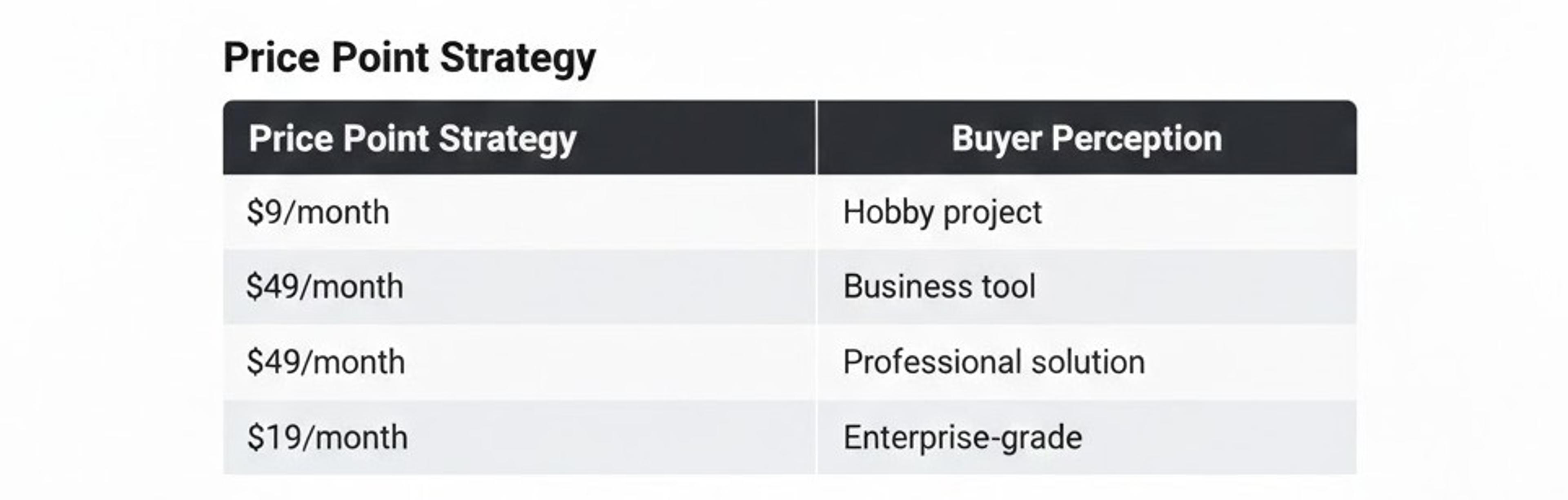
Use value-based pricing to anchor your initial price. Quantify the value your product delivers to a single customer in one month. If your tool saves a user 3 hours per month and their time is worth $50/hour, your product delivers $150/month in value. Capturing 20–30% of that value ($30–$45/month) is a compelling ROI proposition. Charging $9/month for the same value leaves 90% of your value on the table.
A practical rule of thumb from the SaaS pricing research firm Price Intelligently: most indie SaaS tools leave 30% of potential revenue on the table from underpricing. When in doubt, charge more than you think you should. You can always offer discounts. You can almost never raise prices without significant customer communication and churn risk.
Step 3: Structure Your Tiers
Most no-code apps benefit from a three-tier structure:
- Starter — for individuals; price optimized for conversion
- Growth (most popular) — for small teams or power users; your primary target price point
- Pro / Business — for larger users or teams; premium pricing or custom
Price your tiers at roughly 3x intervals: if Starter is $29/month, Growth might be $79/month, and Pro $199/month.
Good tier differentiators:
- Usage limits (records, seats, projects, API calls)
- Advanced analytics or reporting
- Priority support
- Integrations with premium tools
- Team collaboration features
Bad tier differentiators:
- Removing core functionality that makes the product useful
- Punishing free users so aggressively that they can't experience value
Always offer annual billing with a 15–20% discount from day one. Annual subscribers churn at half the rate of monthly subscribers. Present annual pricing as the default on your pricing page.
Step 4: Integrate Stripe Into Your No-Code App
Stripe is the standard for payments in US SaaS products. It handles credit cards, debit cards, Apple Pay, Google Pay, ACH transfers, and dozens of other payment methods. And crucially for no-code builders, every major no-code platform has a Stripe integration.
For Bubble apps: The native Stripe plugin handles subscriptions, one-time payments, and customer portal access with no custom code. Create your Stripe products and prices in the Stripe dashboard, then connect them via the plugin configuration.
For Webflow apps: Memberstack ($49/month) and Outseta both offer deep Stripe integration with user authentication and gated content. For a simple subscription gate, Memberstack is the most popular choice among indie founders.
For Glide apps: Glide's built-in payment feature supports Stripe for simple transactions. For subscription-based Glide apps, integrate via Zapier or Make to trigger Stripe subscription creation.
💡 Pro Tip: Always configure Stripe's Smart Retries for failed payments. Failed payments represent 20–30% of involuntary churn in most SaaS products, and Stripe's automatic retry logic recovers a significant portion of these without any action on your part.
Step 5: Build Your Path to $1K MRR
$1,000 MRR is the first meaningful milestone for an indie no-code product.
This math is one of the most compelling arguments for pricing higher. The difference between 35 customers and 11 customers is enormous at the stage where you're doing everything manually.
The fastest path to $1K MRR for most no-code founders:
- Start with direct outreach to your ICP (warm and cold email)
- Convert your 10 validation interview participants first — they already know and like your product
- Expand through community posting and content marketing
- Set a 90-day target for your first $1K MRR milestone
Track these four metrics weekly:
- New sign-ups
- Trial-to-paid conversion rate (target: above 10%)
- Monthly churn rate (target: below 5%)
- Net new MRR
For the full growth playbook after hitting $1K MRR, see how AI-powered no-code tools can accelerate your product development and user acquisition in 2025.
Conclusion: Monetization is Validation's Final Stage
Getting paid is not the finish line — it is the beginning. The first dollar you receive from a stranger for your no-code product is the moment it becomes a real business. Every dollar after that is confirmation that the value you built is real.
Don't be afraid to charge for your product. The indie founders who build lasting income streams are the ones who price with confidence, structure their tiers with psychological precision, and ask people to pay early — not after months of free users. Your product has value. Price it accordingly.
Related Reading
About the writer

Founder & Writer · EveryTuesdays
You May Also Like
Browse All
Complete SaaS Startup Guide 2026 - Validation to 100k MRR
Launch a profitable SaaS in 2026. Use our 4-week validation framework to hit $100k MRR. Learn LTV/CAC metrics, pricing secrets, and US/AU market entry plans.
No-Code + AI: How Indie Hackers Are Building Apps With Bubble, Lovable & GPT in 2026
AI has supercharged no-code. Discover how indie hackers are combining Bubble, Lovable, and GPT-4 to build smarter apps faster and the tools making it possible in 2026.
How to Validate a No-Code App Idea Before Building Anything (The 2-Week Method)
Stop building apps nobody wants. This 2-week validation method helps indie hackers confirm real demand, find paying customers, and avoid the #1 no-code startup mistake.