Your Nervous System is Running Your Wallet: Fight, Flight, Freeze, and Fawn in Finance
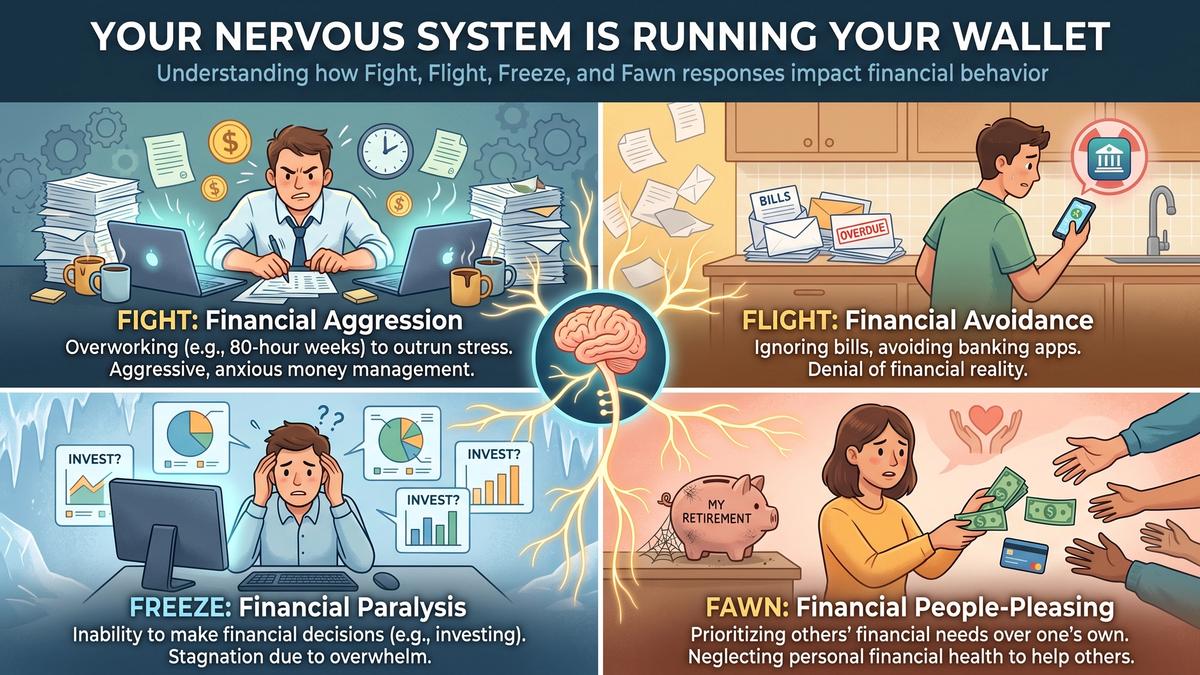
Overworking, avoiding bills, freezing on decisions, over-giving to others these aren't habits. They're survival responses your body chose for you.
Your Nervous System is Running Your Wallet: Fight, Flight, Freeze, and Fawn in Finance
Quick question. When money stress hits, what does your body actually do?
Do you throw yourself into eighty-hour work weeks like you're trying to outrun something? Do you let unopened bills pile up on the counter while you avoid your banking app like it's radioactive? Do you freeze completely, unable to pick an investment option even when you know, logically, you should? Or do you find yourself handing money to everyone else's emergencies while your own retirement account quietly starves?
None of these are personality flaws. None of these are about discipline. They're survival responses, and your body picked one a long time ago without asking your permission.
Money Trauma Isn't Just in Your Head. It's in Your Body.
We've spent the last two days talking about the beliefs and memories that shape your relationship with money. But there's a layer underneath all of that, one that's less about what you think and more about what your body does before you've had a chance to think anything at all.
This is the somatic layer. "Somatic" just means "of the body," and it matters here because financial trauma doesn't live only in your thoughts. It lives in your shoulders, your gut, your breath, your jaw.
When your brain perceives a money situation as an actual threat, and to a nervous system shaped by scarcity or chaos, an overdraft notification can genuinely register as a threat, it doesn't wait for a calm, reasoned analysis. The amygdala fires first. Cortisol and adrenaline flood your system. And your body drops into one of four ancient survival responses: fight, flight, freeze, or fawn.
These responses evolved to help our ancestors survive actual predators. Your nervous system doesn't know the difference between a bear in the woods and a bounced check. It just knows "threat," and it reacts the same primitive way either time.
The Four Financial Survival Responses
Let's break down what each of these actually looks like when the "predator" is a bank statement instead of a saber-toothed tiger.
Fight: Outworking the Fear
The fight response shows up financially as hustle. Not the healthy, purpose-driven kind, the compulsive kind. Overworking to the point of burnout. Taking on aggressive investment risk, not out of calculated strategy but out of a frantic need to outrun scarcity before it catches up.
People in a fight response often look wildly successful from the outside. They're the ones with the packed calendar and the impressive title. But underneath the achievement, there's often a body that's simply never allowed itself to stop moving, because stopping feels like leaving the door open for disaster to walk back in.
Flight: Running From the Envelope
Flight is avoidance in its purest form. Bills go unopened. Banking apps get deleted, or at least never logged into. Financial conversations with a partner get deflected with a joke or a subject change.
This isn't laziness. It's a nervous system trying to protect itself the only way it knows how, by refusing to look directly at the source of the threat. The irony, of course, is that avoidance almost always makes the actual financial situation worse, which then reinforces the fear that started the avoidance in the first place. It's a loop, not a character flaw.
Freeze: The Paralysis of "I'll Deal With It Later"
Freeze is what happens when neither fighting nor fleeing feels possible. The body just shuts down. Financially, this looks like chronic indecision: staring at a 401(k) enrollment form and closing the tab without picking anything, letting raises go unrequested, letting a business chronically under-price its own services.
Freeze often gets mistaken for laziness or a lack of ambition, but it's neither. It's a nervous system that has decided the safest option is no option at all.
Fawn: Buying Safety With Self-Sacrifice
Fawn is the least talked-about of the four, and it might be the most financially expensive. It shows up as boundary violations around money: lending cash to family members you know won't pay it back, saying yes to financial requests you can't actually afford, spending to keep other people comfortable or happy at your own expense.
The fawn response develops in environments where keeping the peace, or keeping someone else calm and satisfied, felt like the only path to safety. As an adult, that can translate directly into a bank account that's perpetually being drained to manage everyone else's needs but your own.
Casey's Story: When Making Money Felt Like Danger
Here's where this gets real. Casey ran a successful business. Clients loved her work, referrals came easily, and by any outside measure, she should have been thriving financially.
Except Casey wouldn't raise her rates. Year after year, she kept her prices well below market value, and worse, she consistently paid herself last, often skipping her own salary entirely to cover business expenses. Friends and colleagues told her repeatedly that she was underpricing herself. She knew this. She agreed with it. And she still couldn't make herself change it.
This is a textbook freeze response, and it took some real somatic work to understand where it came from.
Casey's father ran his own chaotic financial cycle throughout her childhood: periods of grandiose spending, flashy purchases, big promises, followed by devastating crashes into scarcity, evictions, repossessions, panic. Money in Casey's house was never stable. It was either dangerously abundant or terrifyingly absent, and both extremes came with real family fallout.
Somewhere in that chaos, Casey's body learned an unconscious equation: having money leads to family collapse. Not through logic, but through repeated, felt experience. So decades later, when Casey's business started generating real income, her nervous system didn't register success. It registered danger.
Freezing, staying small, keeping her income capped, wasn't self-sabotage in the way we usually think about that phrase. It was Casey's body doing exactly what it learned to do to keep the family, and by extension herself, safe. The freeze was protection, just protection aimed at the wrong threat.
The Five-Breath Reset: A Pattern Interrupt for Your Body, Not Just Your Mind
Since this is a body-based problem, the most effective interrupt is also body-based. You can't think your way out of an amygdala hijack. You have to physiologically signal safety first, and only then does your logical brain get to weigh back in.
Here's a simple practice to use before any money-related task that tends to spike your stress: opening a banking app, checking your portfolio, having a money conversation with a partner, or reviewing an invoice.
Before you open the app or start the conversation, pause and take five deep, slow breaths.
That's it. That's the whole exercise. But the mechanics matter, so here's how to do it properly:
- Breathe in slowly through your nose for a count of four
- Hold gently for a count of four
- Exhale slowly through your mouth for a count of six, longer than the inhale
- Repeat for five full rounds
- Notice, without judgment, where you're holding tension: jaw, shoulders, stomach
Why does this actually work, and it's not just a nice idea? A slow, extended exhale activates your vagus nerve, which is the physical mechanism your body uses to shift out of a stress response and back into a calm, regulated state. You're not managing your emotions with willpower here. You're directly telling your nervous system, through breath, that there's no physical predator in the room.
Once that signal lands, your prefrontal cortex, the part of your brain responsible for actual reasoning and decision-making, comes back online. You go from reacting to a threat to genuinely thinking through a decision. Same banking app, same balance, completely different brain running the show.
This won't undo years of somatic patterning in one sitting. But it interrupts the automatic hijack often enough, consistently enough, that you start creating new evidence for your nervous system: this is safe, I can look at this, nothing bad is happening right now. Over time, that evidence adds up.
Your Body Learned to Survive. Now It Gets to Learn Something New.
Fight, flight, freeze, and fawn were never flaws. They were solutions, brilliant ones, built by a nervous system trying to keep you safe with whatever tools it had at the time.
The problem is just that the threat changed, and nobody sent your body the update.
So the next time you catch yourself overworking, avoiding, freezing, or over-giving around money, try asking a different question than "what's wrong with me." Try asking, "what is my body still trying to protect me from?"
About the writer

Writer
Alice is a Senior Financial Actuary for EveryTuesdays.com. She covers personal finance optimization, statistical market analysis, and data-driven strategies for long-term investing
You May Also Like
Browse All
The Quiet Luxury Secret: Why the Truly Wealthy Look Poor (And the Broke Look Rich)
That $100k Ferrari doesn't prove someone's rich it proves they have $100k less. Here's why real wealth is built to stay invisible.

Earning More Than Your Family: Why Success Feels Like Betrayal
Why does hitting a financial milestone feel like betrayal instead of victory? Your attachment system may be reading success as a threat to belonging.
Why a $47 Bill Can Panic a Six-Figure Earner: Unpacking Financial Flashpoints
Your salary says you're safe. Your nervous system disagrees. Here's why a small bill can trigger full-blown panic and how to trace it back