The Quiet Luxury Secret: Why the Truly Wealthy Look Poor (And the Broke Look Rich)
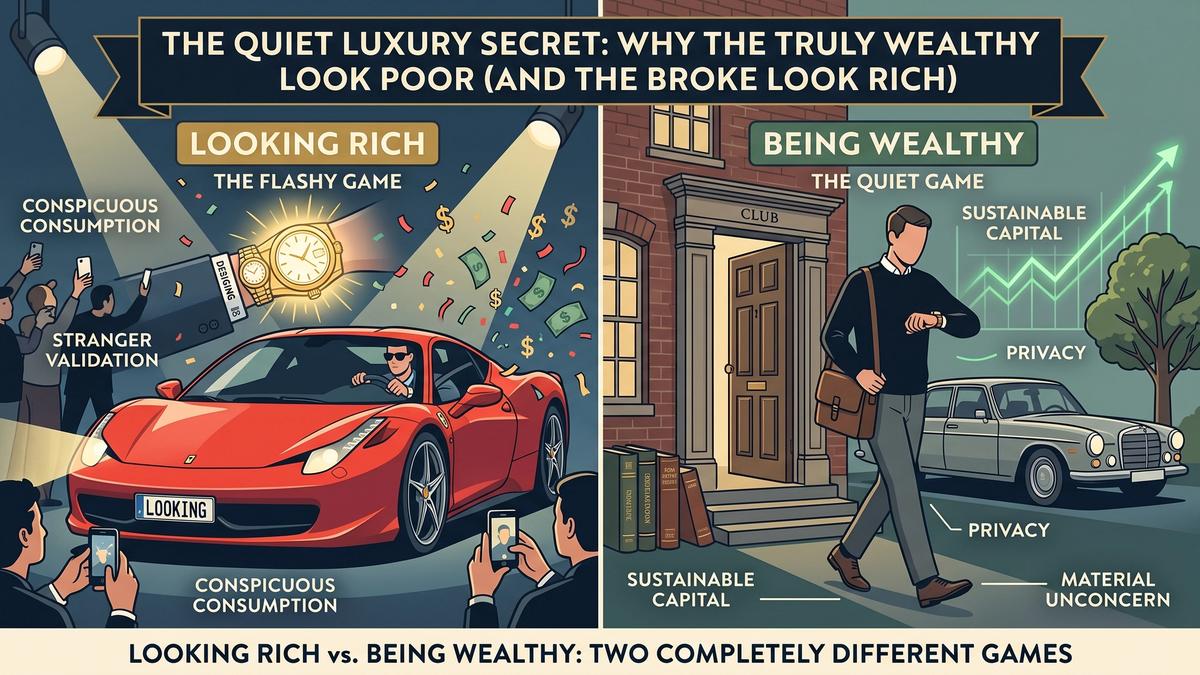
That $100k Ferrari doesn't prove someone's rich it proves they have $100k less. Here's why real wealth is built to stay invisible.
The Quiet Luxury Secret: Why the Truly Wealthy Look Poor (And the Broke Look Rich)
You're at a red light, and a Ferrari pulls up next to you. Without even thinking about it, your brain does something automatic: it assumes that driver is rich.
But here's the uncomfortable truth hiding under that assumption. The only thing you actually know for certain about that person is that they have $100,000 less than they had before they bought the car. That's it. That's the whole verified fact.
Everything else, the wealth, the success, the "made it" story you told yourself in half a second, you made up. And so did they, in a way, because that Ferrari was never really bought for the driver. It was bought for you, the stranger at the red light who'd glance over and feel something.
Let's talk about the difference between looking rich and actually being wealthy, and why almost everyone gets the two confused.
Looking Rich vs. Being Wealthy: Two Completely Different Games
Here's a distinction that changes how you see basically every flashy purchase you'll ever witness. Looking rich means spending your current income loudly, visibly, and often immediately. Being wealthy means holding assets quietly, assets nobody can see just by looking at you, that grow whether or not anyone's watching.
These two things get treated as the same thing constantly, especially on social media, where a beach vacation and a designer bag get read as proof of financial success. But they're not proof of anything except that money left an account. Whether that account had plenty more behind it, or was scraped completely dry to fund the appearance, is invisible from the outside.
As Morgan Housel puts it so simply in The Psychology of Money, wealth is what you don't see. It's the car not bought, the house not upgraded, the vacation not taken, all of it sitting quietly in investments instead, compounding away from public view. Spending money is the most visible way to show people you have it. Which paradoxically means it's often a sign that you have less of it left.
The Man in the Car Paradox
Here's a mental experiment that reframes almost everything about status spending, and it's simpler than you'd expect.
When you drive an expensive, flashy car, what do you imagine is happening in the minds of the people who see you? Most people, if they're honest, picture something like admiration. People noticing you. People thinking, "wow, that person has really made it."
But that's not actually what happens in most onlookers' heads. When people see someone driving a stunning car, they generally don't spend much time thinking about the driver at all. Instead, they picture themselves behind the wheel. The car becomes a prop in their own imagined life, not an endorsement of yours.
This is the Man in the Car Paradox, and it's a little deflating once you sit with it. You bought the car hoping people would admire you. Instead, people mostly used your car as a mirror for their own daydreams, and forgot about you specifically within about four seconds.
If the whole point of the purchase was external validation, and the validation was never actually happening the way you imagined, what exactly did you buy?
Loud Luxury vs. Quiet Luxury: Two Very Different Codes
Once you see the Man in the Car Paradox clearly, it gets easier to spot the two different operating systems people run when it comes to spending.
Loud Luxury: Spending as a Signal
Loud luxury is built around visibility. Logos on full display. Purchases made specifically because other people will recognize the brand and understand its price tag. The goal isn't really the object itself, it's the reaction the object is expected to produce in someone else's eyes.
Loud luxury tends to run on validation. It asks, implicitly, "do you see that I've made it?" And because that question can never really be answered to permanent satisfaction, loud luxury often becomes a treadmill. This year's flashy purchase gets normalized fast, and the itch for the next one starts right back up.
Quiet Luxury: Spending as Utility
Quiet luxury, or what's sometimes called stealth wealth, runs on a completely different code. The goal isn't to be noticed. It's independence, comfort, and quality that holds up over time, regardless of whether a single other person ever clocks the price tag.
Someone operating in quiet luxury might own genuinely excellent, expensive things, a great mattress, a well-made coat, but they're buying for function and durability, not for the reaction of a stranger at a dinner party. The unbranded cashmere sweater. The unremarkable but reliable car. The house that doesn't announce itself from the street.
The real tell isn't the price of what someone owns. It's the question behind the purchase: am I buying this for me, or am I buying this for an audience?
The Valet Roger: A Cautionary Tale in Two Directions
There's a story that circulates in financial psychology circles about a hotel valet who worked for years parking cars for the wealthy. He'd developed a private theory: he could usually guess who had real money and who didn't, just by watching how people behaved, not by what they drove.
One of his regulars was a man we'll call Roger. Roger showed up in a brand-new Porsche every single time, dressed the part, tipped big, clearly enjoying being seen. The valet assumed, like most people would, that Roger was doing extremely well.
Then one week, Roger's Porsche didn't show up. It had been repossessed. Roger wasn't secretly wealthy behind the scenes. He was leveraged to the edge, financing a lifestyle his actual income couldn't support, and the loud signals had been covering for a financial situation that was quietly falling apart the entire time.
Contrast Roger with the profile made famous in The Millionaire Next Door, the unglamorous accountant, the modest small business owner, the person driving a used sedan who never once tried to look rich, because looking rich was never the goal. Their wealth was sitting quietly in index funds and paid-off property, compounding away, completely invisible to anyone who judged them by their driveway.
Roger optimized for the glance at the red light. The millionaire next door optimized for the number in the account nobody else ever saw. Only one of those strategies survives an economic downturn.
The Deserted Island Test: Your Pattern-Interrupt for Every Big Purchase
So how do you actually catch yourself before making a status purchase disguised as a "treat yourself" moment? Here's a simple test to run before any major luxury or material buy.
Ask yourself this exact question: "Would I still buy this item if I were on a deserted island, and absolutely nobody else could ever see it?"
Picture it literally. You're alone. No social media, no friends dropping by, no coworkers, no strangers at red lights. Just you and the item.
- If the honest answer is yes, you still want it purely for how it functions in your life, that's a genuine utility purchase. Go ahead.
- If the honest answer is no, if the appeal completely deflates once nobody's around to notice, that's a signal you were buying status, not the object itself.
This test works because it strips away the audience completely, and the audience is usually where the real motivation was hiding the whole time.
Here's the follow-up step that makes this exercise actually useful instead of just a fun thought experiment: when the test reveals a status purchase, redirect that money on the spot. Instead of buying the item, move that exact amount into an automated investment, an index fund contribution, an extra payment on debt, anything that compounds quietly instead of announcing loudly.
Over time, this simple redirect does something remarkable. It takes money that would have evaporated the moment the social reaction faded, and turns it into the very thing quiet luxury is actually built on: assets nobody can see, growing whether or not anyone's watching.
The Real Flex Nobody Can See
Here's the part that status spending almost never delivers, no matter how loud the purchase: real wealth's highest dividend isn't admiration. It's control over your own time. The ability to leave a job that's draining you. The ability to take a slow morning without checking your phone for work emails. The ability to say no to things that don't serve you, because your financial floor doesn't depend on anyone's approval.
None of that shows up in a photo. None of it turns heads at a red light. And that's exactly the point.
So next time you feel the pull toward something loud, ask yourself honestly: are you buying an object, or are you buying a glance from a stranger who'll forget you in four seconds?
About the writer

Writer
Alice is a Senior Financial Actuary for EveryTuesdays.com. She covers personal finance optimization, statistical market analysis, and data-driven strategies for long-term investing
You May Also Like
Browse All
Earning More Than Your Family: Why Success Feels Like Betrayal
Why does hitting a financial milestone feel like betrayal instead of victory? Your attachment system may be reading success as a threat to belonging.
Why a $47 Bill Can Panic a Six-Figure Earner: Unpacking Financial Flashpoints
Your salary says you're safe. Your nervous system disagrees. Here's why a small bill can trigger full-blown panic and how to trace it back
Are Your Childhood "Money Scripts" Secretly Sabotaging Your Bank Account?
Your bank account isn't broken your beliefs about money might be. Meet the hidden "money scripts" secretly running your financial life.